
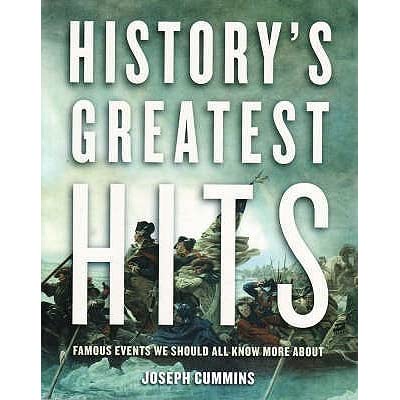
History’s Greatest Hits by Joseph Cummins
2007/315 pgs
History’s Greatest Hit’s is an attempt to pick the most significant hits out of history. However, sadly, it misses the mark widely because some of the events chosen bring to question why a specific event was chosen, and others were not.
For example, The Ancient World 250 BCE-500 AD section, highlights three events. All very important. Hannibal crossing the Alpes, Assassination of Julius Caesar, and the Fall of Rome. That’s it. Those are the only three events you should know from that time. Alexander the Great doesn’t matter. The burning of library at Alexandria. I can forgive leaving Greece’s impact on the world, or China’s, or Egypts…yes this book is very Eurocentric. However, missing the most important and critical event from Roman history…Julius Caesar crossing the Rubicon 49 BC is unforgiving. If a historian narrates vital moments in Roman history for prosperity omitting that pivotal event and why it’s significant to Rome, it begs the reader to ask what else is forgotten. Cummins, however, commits an even more critical error that makes the omission of the Rubicon look minor and insignificant.
Waterloo. The final battle for Napoleon. A significant historical event. Cummins does an excellent narration of the struggle and why Napoleon lost. Sadly, as I read this story, it made me upset, thinking others are reading it and then having discussions about Waterloo and what they thought was factual information. In Cummins’s narration, he states the Seventh Coalition contained forces from Great Britain, the Netherlands, Belgium, and Germany. With an army from Prussia. Causing a double-take on my behalf, re-reading the sentence, and a face slap.
For those reading this and are confused about why I state this, please allow me to explain. Belgium doesn’t become a nation until 1830 after the Belgium Revolution. Germany didn’t exist as a nation until 1871. Even if one wants to state that the forces would have come from what is Germany today, then they can’t say Prussia because Prussia no longer existed after the German unification of 1871 since the King of Prussia, Wilhelm I became the German Emperor or Keizer. The battle of Waterloo was in 1815. Using modern nation titles to describe old forces is wrong, and those that read history will falsely believe that nations have been around longer than they truly have. For those that would read this and say that’s minor, then why didn’t Cummins in the Ancient world section when talking about Rome state Italy? Yes, proper terms in history do matter.
Finally, as the book gets into the modern era, the 1900’s. Cummins narrates about the battle of the Somme and why it’s the bloodiest day in British Army history. Also, the disaster of Gallipoli and how it almost destroyed the career of Churchill. However, one fact not mentioned, the critical event that has shaped the world as we know it today….the Assassination of Archduke Ferdinand of the Austrian-Hungarian empire, is omitted.
There are many more events that Cummins left out. If he was trying to tell a story of events mostly forget, however, should be remembered. The Gettysburg Address, Kennedy’s Assassination, and many others shouldn’t have been in the book as most people in the United States know about those events. History’s Greatest Hits is not a horrible read.
I enjoyed reading it and took it with a grain of salt, as this is what Cummins views as the Greatest Events.
There are many more errors in the book, and that’s ok. Would I recommend this book, no. As I stated before, if I had time to correct the many errors and add in other events that are very significant, then I would. However, for a history book, this falls very short of its intent.
Enjoy a good book and a cup of coffee.
Lopaka
 nyghteulen