
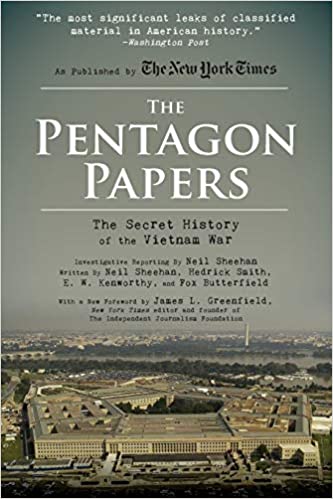
The Pentagon Papers by Neil Sheehan, Hendrick Smith, E. W. Kenworthy, and Fox Butterfield
2017 (1971) / 810 pgs
The Vietnam war, one could argue the single conflict that changed how citizens feel about trusting the U.S. government today. The Pentagon Papers summarizes the papers that were released to news media and printed in 1971. At the time, a hotly contested event that went to the Supreme Court. As of this writing, our equivalent of this is the Snowden leaking of documents to Wikileaks.
Naturally, this isn’t the entire Pentagon Papers as they are many volumes. Historians and reporters sat down and wrote 10 Chapters the summarize a time frame by an event that impacted our involvement in the war. It starts with the Truman administration (1945) and concludes at the Johnson era (1967). Interestingly, Secretary of Defense Robert McNamara commissioned the report in 1967 to allow historians the truth behind the war. One could argue it was him building his case for future judgment on his involvement in the war’s conduct. [Sidenote: A fascinating documentary called The Fog of War has Sec McNamara talking about the 10 lessons he learned in his life included getting questioned about Vietnam]
I did find this very fascinating to read. Although it gets very tedious as you are reading memorandums written with many thoughts and opinions. The format for each chapter is simple. First, the title (significance and time frame), next is a list of highlights, an excellent exposition of the material, finally selected memo’s to support what was written. In the memo’s, more information is added, naturally, that provide more insight.
I found it fascinating reading the truth of why and how we conducted the war versus what was being told to the American people. After reading this, I wish the same thing was written for every conflict we have conducted. For historians, the information is invaluable. Could we imagine how World War 2 would be written if something similar is released with all the leaders’ thoughts that led, planned, and conducted the war? Would they have made the same decision if they knew that their papers and idea would be released in a record for all to read and judge? I firmly believe that all leaders should read this and keep a copy near them on their work desk to think about when they make decisions that impact lives.
Would I recommend this? Only if you are interested in history or the truth of the Vietnam War. Many times I almost fell asleep reading the monotonous memo’s that leaders wrote. I did enjoy it, and it will have a place at my desk.
Favorite line: June 1964, President Johnson asked the C.I.A Director about the actual probability of the Domino Theory. He was informed on the 9th of June, “With the possible exception to Cambodia – it is unlikely that no nation in the area would quickly succumb to Communism as a result of the fall of South Vietnam.” – The Pentagon Papers
Enjoy a cup of coffee and a good book!
Lopaka
 nyghteulen
Pingback: 2021 Reading List | nyghteulen