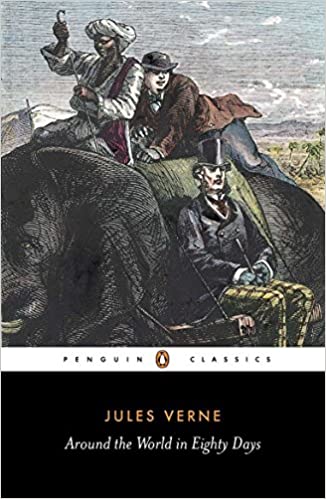
Around the World in Eighty Days by Jules Verne 1873 / 252 pgs Classic
It’s incredible how many classics start from a bet—Green Eggs and Ham, for example. Yet, a £20,000 (roughly £2,200,00 in today’s currency) wager made at a club and our hero, Mr. Philias Fogg, are off with his servant French Passepartout to journey around the world in eighty days.
The Journey would go east from London and utilize mainly Steamers and Trains. However, an elephant ride in India does change the story. As Mr. Fogg had the Journey planned out, it doesn’t go quite a planned as any incredible adventure does, and it goes off course several times. The team rescues a woman in India from being sacrificed in a funeral pyre. All the while, Mr. Fogg is being pursued by Detective Fix, who believes that Mr. Fogg was the thief that stole £50,000 from the Bank of England and desired the reward money.
This novel is a classic of Vernes that, once I picked up, I couldn’t put down. It is a beautiful read with twists and turns that keeps the reader on their nerves. He does world descriptions like Journey to the Interior of the Earth. However, not in nauseating details like 20,000 Leagues under the Sea. Just enough to make the story even more believable.
I would recommend this book for a good journey with Mr. Vene.
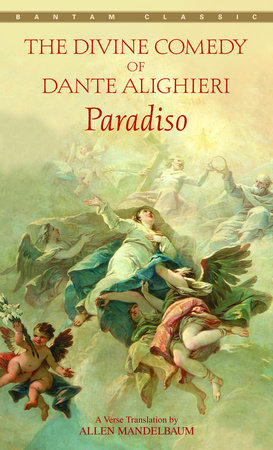
The Divine Comedy: Part 3 Paradiso by Dante Alighieri 1472 / 368 pgs Classic
The Divine Comedy isa very long poem broken into three parts Inferno, Purgatorio, and Paradiso. Dante and his guide Virgil, another poet who wrote the classic Aeneid, travels through Hell, Purgatory, and Heaven to reunite Dante with his dead girlfriend, Beatrice in Heaven. Essentially, The Divine Comedy is a love poem full of horror, brimstone, and punishment.
Paradiso is Heaven. There are ten hemispheres, each called Heaven, to Paradise based on the celestial skies believed to exist at the time. Otherwise, trying to understand why the Sun is the 4th Heaven would make absolutely no sense.
Paradiso is Dante meeting all those important souls who reside in the different levels of Paradise and listening to what they think is wrong with the Church. Like St Peter, St Thomas, and St Bernard, many of these people go on long diatribes about their disappointments with the current state of the Church and what needs to change to get it back to where they envisioned it. Dante and Beatrice leave the earth and explore the solar system and visit the Heavens before meeting with God himself.
Heaven I. The Moon Heaven II. Mercury Heaven III. Venus: The Lovers Heaven IV. The Sun: Theologians and Fathers of the Church Circle I. St Thomas of Aquinas Circle II. The Franciscan Order Circle III. The Resurrection of the Flesh Heaven V. Mars. Martyrs and Crusaders that died fighting for the True Faith Heaven VI. Jupiter. Righteous Kings and Rulers Heaven VII. Saturn. The Contemplative Heaven VIII. Fixed Stars Heaven IX. Primum Mobible Heaven X. Empyrean River of LIght Much more, naturally, is in this book, the Angels’ hierarchy, a description of God himself…which is three rings representing the Trinity.
This book, like the others, is a long poem. Very dense and hard to follow. I’ve had to take my notes a few times and compare them to other reviews to see if I’m on the right track because sections in each of the books become very weird. For example, the Garden visit at the end of Purgatorio, which has to do with a chariot that gets smashed and attacked by an eagle with a fox eating the smashed wood, made me wonder what drugs I needed to understand this scene. However, I also understand that many symbolic representations made more sense when this was written than today.
If I had to make a recommendation, I would only read Dante’s Inferno. That one was fascinating and not as challenging to read as the other two. I’m very glad that I read this classic, and looking forward to another classic soon. For tomorrow, I’m going to enjoy something a little more modern.
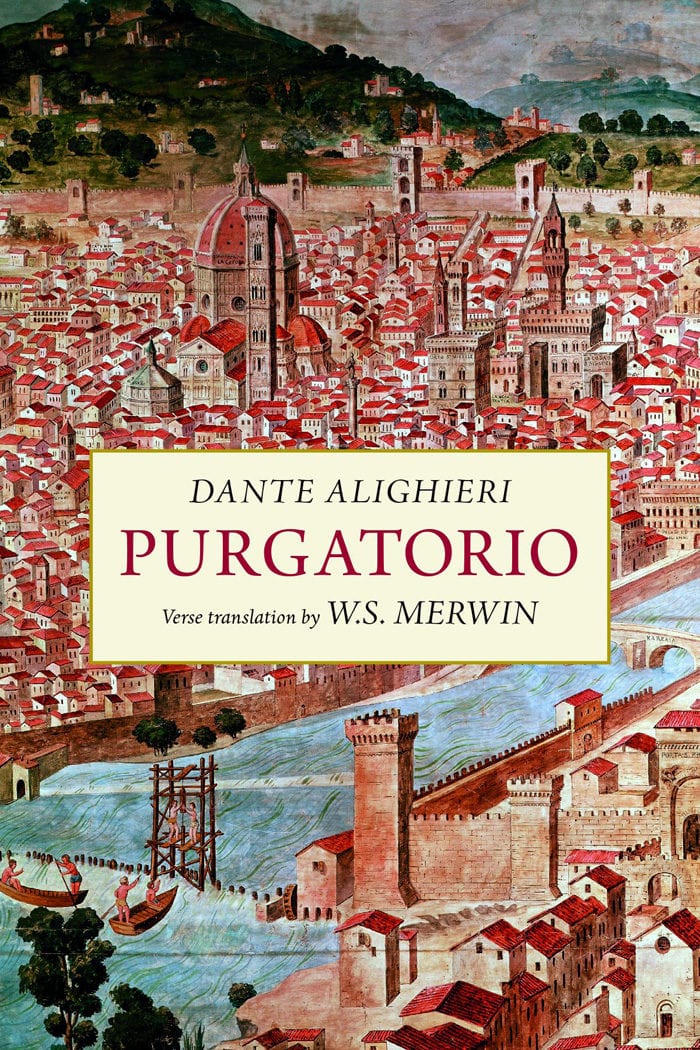
The Divine Comedy: Part 2 Purgatorio by Dante Alighieri 1472 / 181 pgs Classic
The Divine Comedy isa very long poem broken into 3 partsInferno, Purgatorio, and Paradiso. Dante and his guide Virgil, another poet who wrote the classic Aeneid, travels through Hell, Purgatory, and Heaven to reunite Dante with his dead girlfriend, Beatrice in Heaven. Essentially, The Divine Comedy is a love poem full of horror, brimstone, and punishment.
Purgatory is part of the passage that Dante needs to transverse to eventually find Beatrice. He must go through each Circle. Purgatory, in Dante’s vision, is broken into seven Circle’s. Purgatory’s Circles are themed after the deadly sins. For each sin, there is a punishment designed to symbolically represent the sin they committed in the flesh. However, unlike Hell, ones soul eventually rises to Paradise.
Note: Date has many, many side conversations with many people to talk about each sin and how it’s represented. There are 33 Chapters and only seven circles. It takes the first nine chapters just to get to the mountain to start the climb
To get the first Circle, They travel across the large frozen lake and are challenge by Cato of Utica. They are guided to the circle by an angel and meet with those who had presentence right before they died. These Sinners have to wait until they can walk the path of Bismantova (the Mountain).
Virgil and Dante are told they can travel only during the day. They wait and eventually got to the first circle after a lot of talks with Angels and people.
Circle I. The Proud: The condemned arebent over holding large stones.
Circle II. The Envious: Their Eyes are sown shut.
Circle III. The Irascible: Walk around in a blinding smoke.
Circle IV. The Slothful: Engaged in ceaseless activity.
Circle V. The Avaricious and Prodigal: Forced to lie on ground face down.
Circle VI. Gluttonous. Food just out of their reach and they are emaciated.
Circle VII. The Wanton. Standing in a wall of Fire.
Circle VII is in chapter 25, at this point Dante walks into the Terrestrial Paradise and finally is reunited with Beatrice. Sadly, Virgil must leave because he has to go back to Hell. Dante get’s talked to by Beatrice for the next 8 chapters and then finally they enter the garden and start into Paradise.
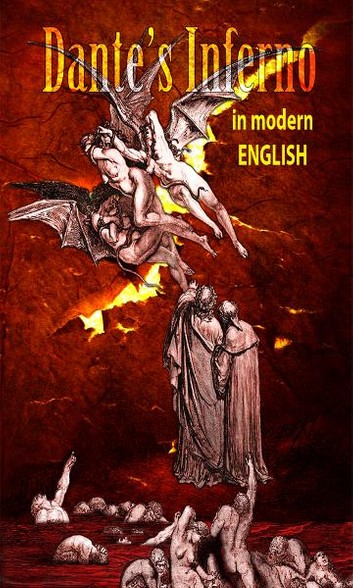
The Divine Comedy: Part 1 Dante’s Inferno by Dante Alighieri 1472 / 251 pgs Classic
The Divine Comedy is a very long poem broken into 3 parts, Inferno, Purgatorio, and Paradiso. Dante and his guide Virgil, another poet who wrote the classic Aeneid, travels through Hell, Purgatory, and Heaven to reunite Dante with his dead girlfriend, Beatrice in Heaven. Essentially, Divine Comedy is a love poem full of horror, brimstone, and punishment.
The Poem itself is interesting; however, also understanding the background of why this was written is very fascinating. However, dear reader, I won’t bore you with many details as you could, if you so choose, Google search and watch many videos and read all about it. I’ll just whet your appetite with a few highlights.
Dante was on the run from Florence as it was taken over by the Holy Roman Empire during a long dispute between the HR Emperor and the Pope on who was in charge.
Dante had a grunge with many Popes and how they were conducting the church, including the current one of his time, and they make an appearance in the Inferno.
Dante was Italian, which is rooted in Roman history, and despises Greece.
Dante was married, not to Beatrice; Beatrice was a girl he meets maybe twice and would be considered a youth crush. However, he never forgot her after she died, and this is why he used her in this Poem.
Now, the palate is pleased. Let’s dive into HELL. (That doesn’t look right, does it)
The Inferno is part of the passage that Dante needs to transverse to get to Beatrice. He must go through each level…and there are many levels to this place. Hell, in Dante’s vision, is broken into Nine Circle’s. A few of these Circles have semi-levels broken within. They take the overall theme for the level and break it down, as we shall see. For each sin/crime, there is a punishment designed to symbolically represent the crime they committed in the flesh and now are eternally suffering for it.
To get to the first Circle, the party must cross the river Acheron via the boat piloted by Charon, Ferryman of the Dead. At the gates, they see the sign that states, “All hope abandon, ye who enter in!” – Dante’s Inferno
Circle I. Limbo: Unfaithful and Unbaptized. They are just stuck, waiting. Nothing happening.
Circle II. Lust: Here, one is greeted by Minos, King of Crete and Judge of the Dead. Here is where ladies like Aphrodite and Cleopatra are residing. Again, just stuck waiting. However, if you must get stuck in hell with Aphrodite and Cleopatra, I’m sure that some wouldn’t consider it torture.
Circle III. Gluttony: The punishments begin! This Circle is guarded by Cerberus, the three-headed hound of Hades. It’s constantly raining.
Circle IV. Wealth [Greed]: Everyone is pushing large boulders to the top of a hill. After they collide in the middle, one side screams “Horde Possession and Money” and the other “Spend freely neglected their value.”
Circle V. Irascible and Sullen [Wrath]: The Circle is the River Styx. In the river, the people are constantly attacking each other. To cross the River, Dante and Virgil have to catch a lift from Phlegyas.
Once reaching shore, our adventures see the city of Dis with its large gates. The first V circles are minor hell. The real fun begins beyond this gate! There are astounded by some demons who try to bring Medusa to turn them to stone. However, an Angel comes down and stops this action and opens the gate to allow our protagonists to continue.
Circle VI. Heretics. Locked in burning tombs.
Circle VII. The Violent. Lovely land with a river of boiling blood flowing through it with Tyrants and Pillagers condemned within. Alexander the Great is here.
As one keeps moving through the Circle, they go into a land of leafless trees that the souls of Suicides are condemned. Any breaking of any branch caused great pain and agony. Harpies continuously feed off the trees.
Finally, they enter a vast desert with raining fire for the souls of those that committed acts against God, art, and nature.
Circle VIII. The Fraudulent and Malicious. This Circle is carved into 10 Bolgia’s (long ditches)
Bolgia I. Seducers and Panders: Condemned walking around and being whipped continuously by demons
Bolgia II. Flatterers: Condemned covered in shit
Bolgia III. Simoniacs: Buried head first with only their legs and feet uncovered so their soles can be burned. There are many Popes buried in the same hole, one on top of another in this method.
Bolgia IV. Soothsayers [Sorcerers]: Heads on backward.
Bolgia V. Peculartors [Politicians]: Condemned are in a lake of boiling tar guarded by the Malebranche that lift them up out and munch on them.
Bolgia VI. Hypocrites: Wear Orange cloaks made of lead.
Caiaphas is here crucified to the ground, so everyone that past must walk on top of him.
Bolgia VII. Thieves: They are in a pit of snakes that bite them and either change them into other forms or cause them to fall and be destroyed in flames, only to be reborn and bitten again.
Bolgia VIII. Evil Counselors: Condemned is ablaze in individual flames.
Bolgia IX.Schismatics: Condemned are continually being chopped, split, or pierced only to heal up and go again.
Bolgia X. Alchemists. They are suffering from many diseases.
Circle IX. Traitors: Like the previous Circle, this is broken into 5 divisions. Also, interestingly the entire Circle is the frozen lake of Cocytus.
As Dante and Virgil reach the final layer, they find three giants, two frozen and one not on the outer layer. The free Giant lowers them into the last Circle.
Division I. Caina: Named after Caine, this is Traitors to the Kindred. Frozen in the ice up to their necks, but their heads can rotate.
Division II. Antenora: Traitors to their country, Frozen to their heads, and they can’t move.
Division III.Ptolomaea: Traitors to the friends. Frozen in the ice.
Division IV.Judecca: Traitors to their Lords and Benefactors. They are just frozen in the ice.
Lucifer – Reserved for betrayers to God himself: Frozen up to his waist in ice but moves above. He has three faces on one head. Large bat wings always flapping, keeping the wind and cold air moving. His three mouthes are reserved for the most heinous of sinners. On the left is Cassus, and on the right is Brutus. The center is Judas Iscariot.
To leave Hell, Dante and Virgil climb down and then up Satan’s leg to break through and see the Mountain, which is part 2 of their journey.
This is just a summary of what the Inferno is. Many times Dante stops to have a conversation with someone. A few times, they have to have guides or even mounts to get them through a circle. It took me about 4 days to read through this part. The poetry has no rhyme to it, and it’s ancient compared to more modern poetry. I often had to slow down and reread a line to ensure I understood what Dante was saying. This is a very dense reading. However, it’s delicious to challenge one’s mind with complicated writing. This is a classic that should be read.
Naturally, I started Part II already. That will be the next review.
 nyghteulen