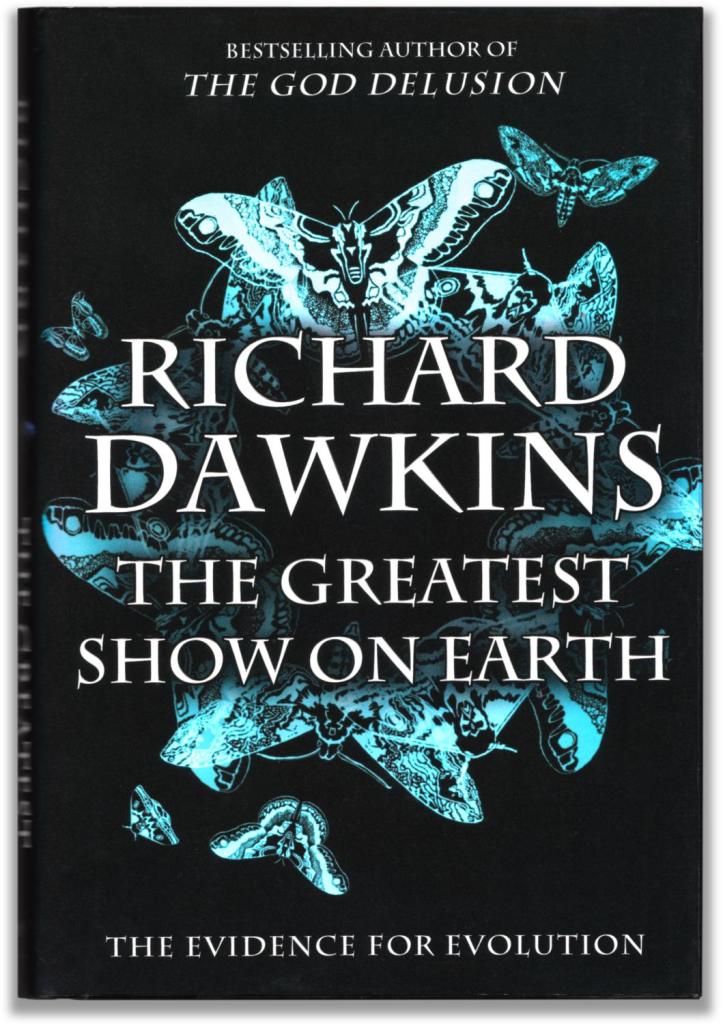
The Greatest Show on Earth by Richard Dawkins 2009 / 426 pgs
A song by Symphonic Metal band Nightwish, called The Greatest Show on Earth from the album Endless Forms Most Beautiful created the desire to read this book. It wasn’t a disappointment.
This is Professor Dawkins need to provide evidence for the Theory of Evolution and how Creationism and/or Intelligent Design is wrong and shouldn’t be taught in schools. I didn’t need convincing on this. The reading was very down to earth, although Professor Dawkins is British and uses words we that required me to have a dictionary standing ready.
The book goes point by point giving anyone the tools to fight the creationist and prove that Darwin is correct in our evolution. There were many points made in the book and if any creationist where to read this book and walk away thinking that Professor Dawkins didn’t prove anything, then there is no changing their minds.
This book is very well written and I would absolutely recommend it for any science nerd.
One of my favorite quotes is the final sentence from Darwin’s first edition of Origin of Species which Professor Dawkins breaks down in the final chapter. “There is grandeur in this view of life, with its several powers, having been originally breathed into a few forms or into one; and that, whilst this planet has gone cycling on according to the fixed law of gravity, from so simple a beginning endless forms most beautiful and most wonderful have been, and are being, evolved.” – Charles Darwin
My American Journey by Colin Powell with Joseph E. Persico 1995 / 612 pgs
I, like many, have a wish list of desired books to devour. This one has been on this list for many years. I found a hard copy at a used book store and sat down with it with my eager mind ready to dive in. It didn’t disappoint by any stretch of the imagination!
Colin Powell’s journey from New York to through ROTC and eventual rise to become Chairman of the Joint Chiefs of Staff is not a normal journey for any officer in any of the services. As he went along his path, he faced many challenges not only in the forests of Vietnam but also the rasim that raged in the nations south in the 1960’s. As I read his trials and tribulations dealing with racism and his thoughts and his message for the nation and even individuals, I realised this book was published in 1995 and we are still dealing with it today, 25 years later! People who haven’t read My American Journey should because it is painful to realise the truth that, yes, we as a nation have gotten better over time, but we are still dealing with this ugly multi heading snake today.
Reading about Gen Powell’s journey and how it impacted his family as some dream jobs he finally attained, like command of V Corps, before he even gets half way through the traditional command, he is pulled back to Washington to sit at the highest position guiding our nations international policies. How he believes a few times that this is the end his journey, however, it keeps going. While the family with move after move is impacted. Military families sacrifice a lot to follow those that serve their nation and this one made many!
This book is very inspirational and I would absolutely recommend it!
One of my favorite quotes “Leadership is the art of accomplishing more that science of management says is possible.” – Gen Colin Powell
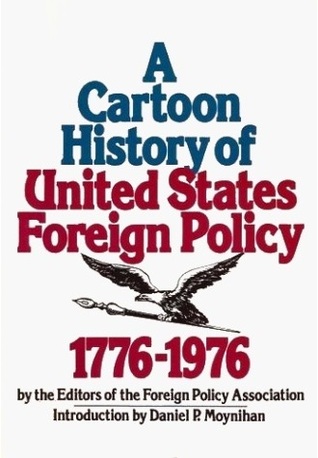
A Cartoon History of United States Foreign Policy 1776-1976 by the Editors of the Foreign Policy Association 1976 / 196 pgs
This is a easy read. First, it’s a simplified foreign history narrative of the United States from 1776 to 1976. Not much depth involved because the star is the comics that are shown with each commentary event. What is fascinating is seeing the evolution of political cartoons over the last 200 years. However, it’s not multiple comics for one event, just a few, if not just one, comic. Starting with the infamous divided snake drawn by Benjamin Franklin before for the United States was formed to reaction to events in 1776 to the view of United States influence over the United Nations after Vietnam, the “loss of China”, and resignation of Nixon.
For those that enjoy history with a sense of humor, this is a quick and fascinating read. Again, if you are versed in United States history, there is very little learning from the narrative. The comics are fun to read and interpret though.
The Craft is a simple book written for Masons to understand the symbology of the three degree’s as the start and continue their journey along the masonic path.
What it does do is help a mason understand what each thing symbolizes. It doesn’t break down every secret of Masonry. If one is looking for each ritual that a mason endures, this is not the book. This just helps explain what each item represents along the path.
This is a wonderful book to give to a spouse or any family member that has questions about masons. For a mason, this is a wonderful tool to remind them on their journey and remember some of the symbols they may have missed on the path.
For those looking for more secrets, this is not the book. It’s a very easy and fast read.
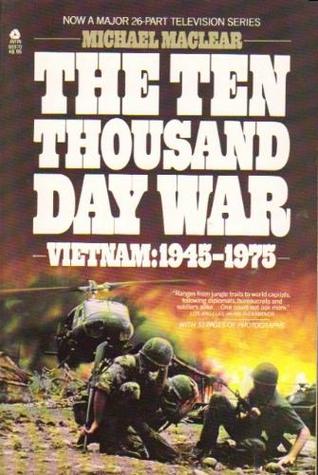
The Ten Thousand Day War – Vietnam: 1945-1975- by Michael Maclear
1981/369 pgs
Vietnam, a war that changed everything about America and how the citizens trust the government. This novel is about the history of the war and when the United States got involved and why. As the title suggested, it starts with the United States’ support for Indo-China against the Japanese in 1945. It ends with the fall of Saigon on 30 April 1975.
It’s a very well study of the war and hits all the major points in 20 Chapters. It dives into the infamous French loss at Dien Bein Phu that caused them to leave Vietnam. Like a snake, it weaves into our involvement with the South and how the cold war keyed our participation. From each administration that had a roll with Vietnam, from Roosevelt to Ford, Maclear shows the many times that we were projected to leave. He paints a shocking picture of the Assassination of the president of Vietnam and how it impacted JFK, who would be killed only a few months later.
He showed how Johnson wanted to win the war and create the Great Society only for all his ambitious plans for fall because of Vietnam. One of the great highlights is 1968 and how that impacted the United States starting with the Tet Offensive.
This historical tale was easy reading, and not every paragraph crammed with in-depth knowledge. I absolutely enjoyed reading this and would recommend to anyone that wants to know about Vietnam and why it still is an impact on the United States today.
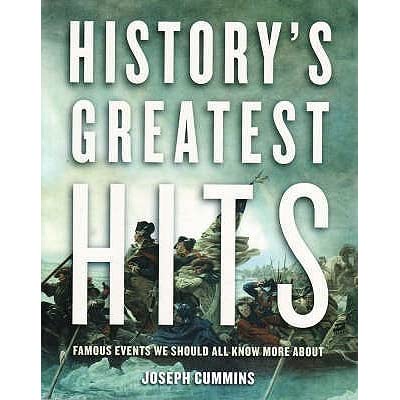
History’s Greatest Hit’s is an attempt to pick the most significant hits out of history. However, sadly, it misses the mark widely because some of the events chosen bring to question why a specific event was chosen, and others were not.
For example, The Ancient World 250 BCE-500 AD section, highlights three events. All very important. Hannibal crossing the Alpes, Assassination of Julius Caesar, and the Fall of Rome. That’s it. Those are the only three events you should know from that time. Alexander the Great doesn’t matter. The burning of library at Alexandria. I can forgive leaving Greece’s impact on the world, or China’s, or Egypts…yes this book is very Eurocentric. However, missing the most important and critical event from Roman history…Julius Caesar crossing the Rubicon 49 BC is unforgiving. If a historian narrates vital moments in Roman history for prosperity omitting that pivotal event and why it’s significant to Rome, it begs the reader to ask what else is forgotten. Cummins, however, commits an even more critical error that makes the omission of the Rubicon look minor and insignificant.
Waterloo. The final battle for Napoleon. A significant historical event. Cummins does an excellent narration of the struggle and why Napoleon lost. Sadly, as I read this story, it made me upset, thinking others are reading it and then having discussions about Waterloo and what they thought was factual information. In Cummins’s narration, he states the Seventh Coalition contained forces from Great Britain, the Netherlands, Belgium, and Germany. With an army from Prussia. Causing a double-take on my behalf, re-reading the sentence, and a face slap.
For those reading this and are confused about why I state this, please allow me to explain. Belgium doesn’t become a nation until 1830 after the Belgium Revolution. Germany didn’t exist as a nation until 1871. Even if one wants to state that the forces would have come from what is Germany today, then they can’t say Prussia because Prussia no longer existed after the German unification of 1871 since the King of Prussia, Wilhelm I became the German Emperor or Keizer. The battle of Waterloo was in 1815. Using modern nation titles to describe old forces is wrong, and those that read history will falsely believe that nations have been around longer than they truly have. For those that would read this and say that’s minor, then why didn’t Cummins in the Ancient world section when talking about Rome state Italy? Yes, proper terms in history do matter.
Finally, as the book gets into the modern era, the 1900’s. Cummins narrates about the battle of the Somme and why it’s the bloodiest day in British Army history. Also, the disaster of Gallipoli and how it almost destroyed the career of Churchill. However, one fact not mentioned, the critical event that has shaped the world as we know it today….the Assassination of Archduke Ferdinand of the Austrian-Hungarian empire, is omitted.
There are many more events that Cummins left out. If he was trying to tell a story of events mostly forget, however, should be remembered. The Gettysburg Address, Kennedy’s Assassination, and many others shouldn’t have been in the book as most people in the United States know about those events. History’s Greatest Hits is not a horrible read.
I enjoyed reading it and took it with a grain of salt, as this is what Cummins views as the Greatest Events.
There are many more errors in the book, and that’s ok. Would I recommend this book, no. As I stated before, if I had time to correct the many errors and add in other events that are very significant, then I would. However, for a history book, this falls very short of its intent.
It’s been a while since my last posting. While it may look like I’ve stopped posting or even reading, the desire to pick up a good novel has been driving inside me more than before. As we all know, life gets in the way, and in my case, it’s Graduate School that is the subject of my affection for the last two years. Since I finished Salem’s Lot, I’ve finished writing my Comprehensive Exams and just completed, hopefully, my final class for my degree. Now, to pick a book to read and get lost in another world.
Now, to open the cover and devour another world and share it will all of you that enjoy my reviews. Until then…
Stay Safe in these challenging times, enjoy a good cup of coffee, and a good book!
What would happen if Dracula came into our current world. This is the infamous premises that Mr King built this story from. Although the book is a good read and I would recommend it to anyone, it’s not a very fast read. It doesn’t hook you in like It. The novel starts with a author returning to his home town, Jerusalem’s Lot, to write a new novel. The other reason was to face a childhood experience and nightmare that has haunted him about the Marsten house. The house is the infamous house that resides in every small town, the haunted house the murdered ghosts still roam today.
After our protagonist arrives in town and actually inquired about the house because he wanted to rent it, he discovers that it was recently purchased. The new owner and his partner also open a antique store in the town and soon after, people begin to disappear and come back to life to take the life of someone else by sucking their blood to ease the craving that is building inside. The infamous vampire has arrived.
If one has read Dracula, they can definitely see the influence Mr Stoker had on Mr King. The story is not identical and the plot is not the same. Howeve r in some of the plot ides’s you can definitely see Mr. King’s salute to the story that started it all.
As mentioned, I would recommend this book. It was a fun read, again, I never got to the point that I couldn’t put it down. It still is a wonderful story and in the end, it makes you wonder if there is more. Father Callahan is first introduced in this book.
Another year gone by and some wonderful books completed. I hope everyone got their reading goals completed. This year I personally will be adding 5 more books to my goal. 25. Also, another goal is to dedicate 1 hour a day to reading. This will be an interesting challenge.



 nyghteulen