The Guns of August

The Guns of August by Barbara W. Tuchman
1962
 / 511 pgs. History/Military and War

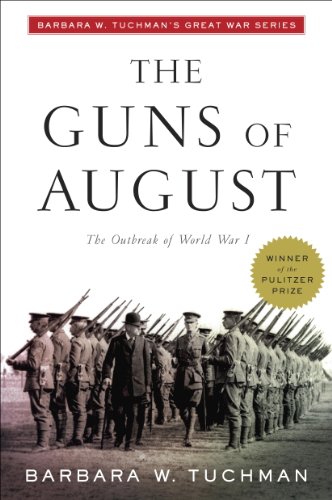
The Guns of August
is a historical masterpiece!  While I was reading, I never wondered how much longer I have to go or when it is going to end.  I just wanted to read more without looking up the key players to discover what happens to them.

The Guns of August is about the first and most critical month of World War One.  It starts with a narrative of events before the war—specifically, the planning of operations and treaties that were signed between nations before the conflict.  Also, very fascinatingly, the joint planning between the British and French military for contingency plans in case Germany attacked France through Belgium.  The riveting detail was these plans were started in early 1900’s.  Also, both the French and British planners understood the critical need for a combined commander of all forces on the Allied side if hostilities started.  Yet, in the first critical month, the BEF Commander in Chief refused to allow the BEF to fall under the French leadership of Joffe.

The assignation of Archduke Franz Ferdinand of Austria by the Black Hand, the single event that changes the face of Europe and power in the world, is just mentioned briefly in the book.  The month that all the critical decisions that led to the war’s start are a simple sentence.  If you are hoping for details about that month, this is not the narrative to read.  The focus of this narrative is the first month of the war.

After Austria declares war on Serbia, the main focus turns to the French and German military’s execution of Plan 17 and the Schlieffen plan.  How the Joffe’s refusal of deviation of Plan 17 even when the situation called for moving of forces to counter the German offensive. Molke’s changes to the Schlieffen offensive before the conflict. His melancholy during August and the lack of secure communication that would play critical roles in the German offensive that would prevent the Schlieffen plan from being executed and even a complete German victory within just over a month. 

Overall, this is a fantastic read.  It is definitely on my top five list for history books, along with At Dawn We Slept.  I’m already looking forward to reading more by Barbara Tuchman.  For anyone interested in reading about the start of World War I, I would highly recommend The Guns of August.       

Enjoy a good cup of coffee and a wonderful book!

Lopaka

Incredible Victory

Incredible Victory: The Battle of Midway by Walter Lord
1967
 / 268 pgs. History, Military and War

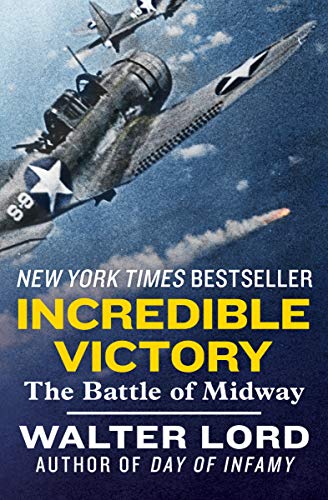
Incredible Victory
is a Walter Lord history classic. It’s a detailed account, very similar to Miracle at Midway, of the planning and attack from both sides of the battle of Midway.  There are a few minor details between both books that are interesting; however, they don’t change any of the impacts of the fight. 

A fascinating point illustrated in both books is the “fog of war.” The in-validness of accounts as told by those that fought in the battle.  Both sides paint a different picture that makes a historian’s job more challenging trying to chronicle events.  Also, the written history by both nations after the battle and official reports.  When comparing the reports, there are very vast discrepancies on both sides.  However, it’s understandable that no one has time to write down precise information on what happened when in battle.   They leave that to the historian to sort out through logs, diaries, and interviews. 

Walter Lord pointed this out at the end of the book in a final section, mentioning that many U.S. Navy pilots swear they properly identified the Carrier based on the location of the Island.  However, the island location wasn’t the proper one for the Carrier they believed they attacked.  Also, taking in the official records of the first wave, the Akagi and Kaga were attacked, and no one bombed the Soyru.  The infamous “fog of War.”  

Overall, this is a beautiful read and easy to follow.  For anyone interested in reading about Midway’s Battle, I would recommend either Incredible Victory or Miracle at Midway.        

Enjoy a good cup of coffee and a wonderful book!

Lopaka

The Forward Collection

The Forward Collection
by Various Authors 2019
 / 272 total pgs. Fiction

The Forward Collection is six short stories written by authors from an idea thought of by Blake Crouch.  Amazon shows them as six different books.  The longest story is 74 pgs, and the shortest is 27 pgs.  They are all quick reads.  For the sake of brevity, I’ll post them as one book.  Also, I won’t give away the whole plot.         

Ark by Veronica Roth  39 pgs   

The Earth is near the end as an Astroid is about to collide with it.  Only scientists that are identifying plants from the seed stations are left.  At the final minute, they will depart with the last two rockets and seeds from the stores.  Only one of them has a different plan.


Summer Frost by Blake Crouch 74 pgs

During the development of the video game Lost Coast, a minor NPC starts to act independently and think beyond its original programming level.  Its creator, Sam, wants to explore its potential and what could be the first true A.I.      

Emergency Skin by N.K. Jemisin 32 pgs

Many years ago, humanity left the Earth because it was becoming inhabitable.  Now, one has come to a planet with a special mission to collect cell samples needed back on the new Earth.

You have arrived at your Destination by Amor Towles 45 pgs

Sam and Anne need an IVF to have children.  Sam is given three different presentations with future potential plans at the clinic to choose their ideal child.

The Last Conversation by Paul Tremblay 55 pgs

You wake up not knowing where you are or why you are there.  A lady walks in and starts helping you in your recovery.  You have many questions, and she has a few answers.

Randomize by Andy Weir 27 pgs

A husband and wife come up with a scheme using computers to win over $700,000 in Kino.    

Overall, these short stories were fun to consume.  Ark, Summer Frost, and Emergency Skin were exciting.  You have arrived at your Destination was interesting, not thrilling.  Last Conversation and Randomize were O.K. It’s a beautiful collection to get introduced to new authors.  I will be interested in Crouch, Jemisin, and Towles books in the future. 

Enjoy a cup of coffee and a good book.

Lopaka

The Prince

The Prince
by Niccolò Machiavelli 1532  / 96 pgs. Politics

The Prince is not a story. It’s a political thesis.  Machiavelli analyzed historical leaders and used their success and failures as examples of how a prince should rule their kingdom.  Machiavelli looked at two ways a prince may rise to power eventually to lead a territory, by force or inheritance.  Machiavelli’s analysis is once one gains power, these are the steps to retain it.

The Prince shows how politicians, even today, utilize their ability to retain and use power.  The most famous point in the thesis for a leader is “it’s much easier to be feared than loved.”  When a Prince is feared, it’s easier to enforce control.  Leaders should always be saying they are working to make citizens’ lives better; however, they are ready to take down any question to their power.  Another way is Politicians can’t be honest and must use whatever tactic, included making promises they never intend to keep, to gain and retain power.  The immoral method is the only method of a politician.    

The Prince
almost reads like a guide for Dictators.  However, understanding that when Machiavelli wrote The Prince, he was in exile from his beloved Florence.  He was a politician for 14 years, and after the government was overthrown, he was tortured for conspiracy.  While he was away, he wrote several books and The Prince.  Understanding why he was exiled could also mean The Prince is a warning to citizens of tyrannical rulers’ tactics to obtain power and influence and keep it.         

The Prince is an essential political thesis.  It is short, only 96 pages, however, very dense.  It took me four days to finish reading it.  If you want a book to get lost in, this isn’t it.  If Politics/Government/History is your cup of tea, I would highly recommend it.

Enjoy a good cup of coffee and get lost in an excellent book,

Lopaka

The Autobiography of Benjamin Franklin

The Autobiography of Benjamin Franklin
by Benjamin Franklin 1791
 / 151 pgs. Biography

The Autobiography of Benjamin Franklin is listed as a must-read for great American works.  It doesn’t disappoint.  Franklin was writing it in the last ten years of his life and was unable to finish it.  He started writing it in 1771. Beginning in 1720, when he was 14 and moving through his last entry for 1757, it covers his earlier years.  Naturally, many would like to read about the years not written as Franklin died in 1790 at 84.

However, the book still gives an excellent view of Franklin’s fascinating world and how he thought and created his political and business viewpoints.  Most know of the stories that he was a founding father of the United States, the United States Minister to France during the Revolution, printer, and scientist.  Naturally, those are the highlights in U.S. history books.

What this biography shows is how truly a renaissance man he was.  In 1733, he taught himself French, then Italian, Spanish, and Latin.  He was a lover of books and didn’t enjoy drinking throughout the day.  His first son died of Small Pox.  Franklin could have gotten him inoculated and regretted not getting the procedure completed.

Franklin founded an Academy for poor children to gain a higher education for free called the Academy and College of Philadelphia and was its First President.  Today the Academy is called the University of Pennsylvania.

Franklin’s biography goes into much of his early life. It’s not a fast read as there is much information in each paragraph.  The way it’s written makes the reader sometimes forget they are reading an Autobiography.  After finishing it, I now understand that Franklin kept vastly detailed journals.  I was sad to discover what I desired to devour, his insights and thoughts from 1760-1788, were never finished as he died before he could complete them.  However, I wasn’t disappointed by any of this book.  I would recommend it if you want to learn about how Franklin developed himself into the man we know in today’s history books.       
              

Enjoy a good cup of coffee and get lost in an excellent book,

Lopaka

Next Read – The Prince by Niccolò Machiavelli

A Night To Remember

A Night to Remember
by Walter Lord 1955
 / 164 pgs. History

A Night to Remember is the narrative of the sinking of the most famous ocean liner in history.  It is considered the holy grail of the sinking of the Titanic.  Mr. Lord interviewed 63 survivors, utilized maps, newspaper articles, and memoirs to retell that infamous night of 14 April 1912.  A Night to Remember (1958) and Titanic (1997) used Walter Lord as a consultant and the book as guide for the narrative.

The story the moment, 11:40 p.m., when Lookout Fleet spots the Iceberg and radio’s the bridge of the infamous words “Iceberg right ahead.” From there, the narrative plays out, as many have seen in the movies.  A 300-foot gash is torn through the hull of the ship and starts flooding the first five compartments.  Mr. Andrews, the ship’s designer, is summoned and, after inspecting the damage, states the Titanic will flounder.  The truth then comes to light, the Titanic only carried enough lifeboats for 1,178 people, and there were 2,207 on board. 

From this moment, the narrative of the events starts with passengers being loaded into the lifeboats, the infamous women and children first.  Also, the story of the Californian and why she didn’t respond.  The CQD sent from Titanic via morse code and changed to S.O.S, telling all available ships to come to her aid.  From the moment the Iceberg hit the boat to her going under is half of the book.  The other half is the survival of those on the lifeboats and the rescue by the Carpathia.  The narrative of what the Carpathia did to come to the aid of the survivors is thrilling to devoir.  Finally, the story ends with the arrival in New York and the truth of the disaster being told.

This book is a fast read as I finished it in about 4.5 hours. It’s a grand narrative of what happened including the thoughts of many of the passengers and how they believed events played out that night, bringing a different perspective of the sinking.

I would recommend this for anyone to enjoy reading about A Night to Remember.                     

Enjoy a good cup of coffee and get lost in an excellent book,

Lopaka

Next – The Autobiography of Benjamin Franklin

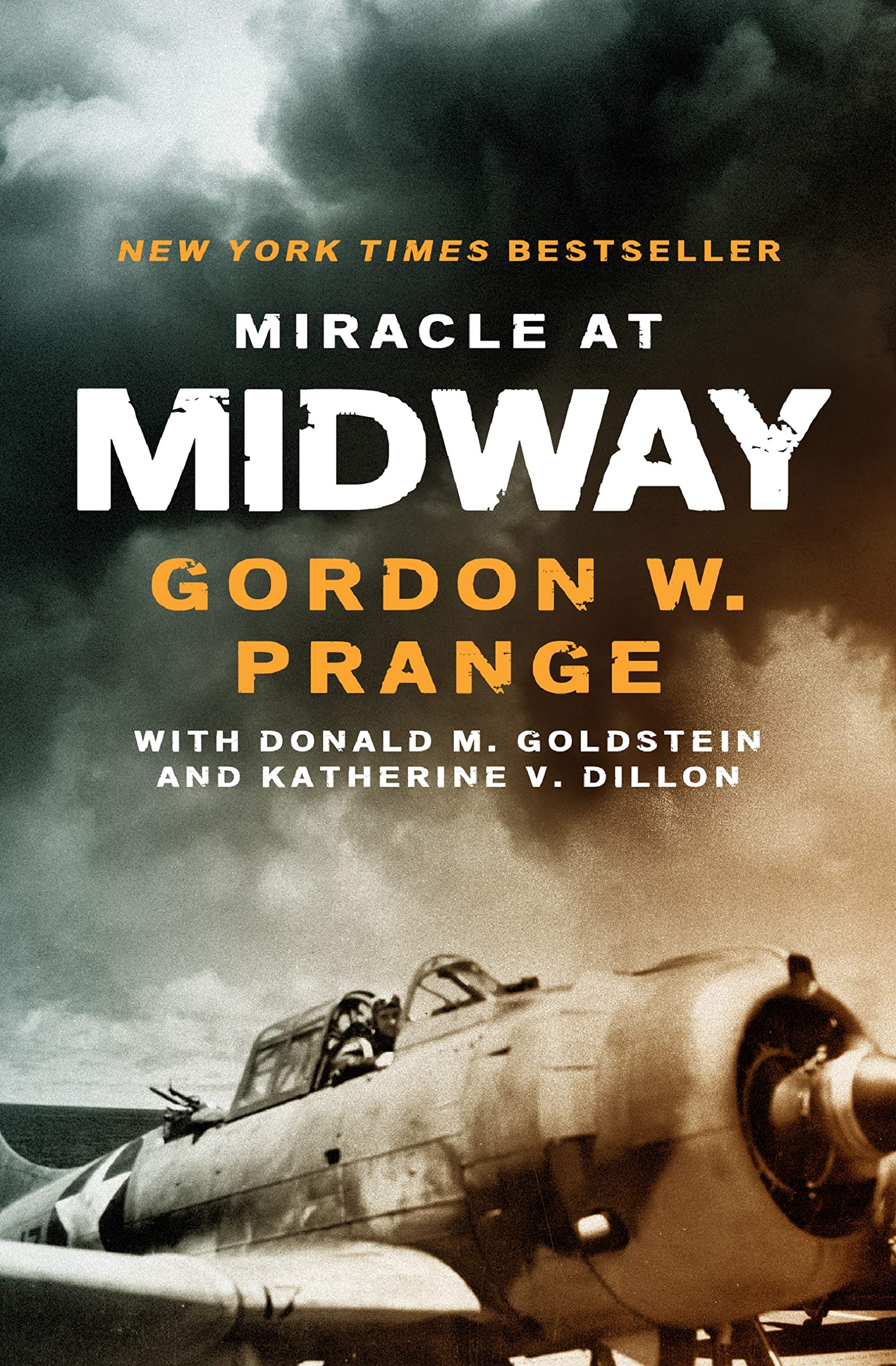
Miracle at Midway

Miracle At Midway
by Gordon W. Prange, Donald M. Goldstein, and Katherine V. Dillon 1983
 / 469 pgs Military History

The battle of Midway is known as the turning point of the Pacific War.  The story is well known to those that have read about World War II.  The Imperial Japanese Navy lost four Aircraft Carriers, and the U.S. Navy losing the U.S.S. Yorktown (CV-5).  With the Japanese Carriers sunk and the loss of their very experienced pilots was to prove a disaster for the Empire that would never be on the offensive for the duration of the war.

The two movies about Midway tell a simplified version of what happens.  However, like all movies, there is more to the story than can be put on the film.  Miracle At Midway is a detailed account of the battle.  Unlike, At Dawn We Slept, there is not as much depth of the political games that brought the Japanese to this crucial battle. 


The fascinating section of the story is not what you would know from the movies, but the details that are left out of any standard Midway telling.  For example, how B-17’s and B-26’s from the USAAF bombed the Japanese fleet.  Their impact was minimal to nil; however, most people don’t know that any USAAF bombers were used in the battle. 

Another fascinating part that is lost to history was the first American aircraft to score a hit on the Japanese at the battle.  It wasn’t a carrier-born aircraft as most stories and even the movies tell.  It was a P.B.Y. Catalina rigged with a torpedo and scored a hit on the Akebono Maru in the Invasion Force.  The Catalina didn’t do much damage. Interestingly, it was the only successful U.S. torpedo attack during the entire battle!.  The P.B.Y. wasn’t the only aircraft that was rigged with a torpedo.  The USSAF rigged a torpedo to the B-26; however, their attack was unsuccessful.   

These are just a few of the fascinating and detailed stories that tell the whole narrative about the Battle of Midway.  Just like any History/War book, if it’s your cup of tea, you would enjoy this book.  If not, I would stay away from it.  I enjoyed reading it; it’s not as good as At Dawn We Slept. However, if you want a good read on the Battle of Midway, I would recommend it. 

Enjoy a good cup of coffee and get lost in an excellent book,

Lopaka

Next – A Night to Remember

Invisible Man

Invisible Man
by Ralph Ellison 1952
 / 592 pgs Bildungsroman/African American Literature

Invisible Man has been popping up on my radar a few times to read.  It is a challenge to devour.  However, it is an outstanding novel.  It will make your butt squirm in the chair as your comfortability is questioned.  It can also make you upset and feel with the character, which is the point behind the writing. It’s not supposed to be an easy, simple read.  It makes you think about yourself and the struggle of others; this is the gift of the Invisible Man.       


The narrator is unnamed, the Invisible Man (IM), who is challenged about who he is around every corner.  In the beginning, he gives a valedictory speech at his high school graduation. He is invited to give the same address at a meeting of the town’s leading men.  He prepares vigorously to give the speech.  After arriving at the ballroom to provide his address, he is forced to participate in a boxing battle royal, even blindfolded before he can give the speech.  He doesn’t win; however, in the end, he is told to give his address, and he does with a mouth full of blood.  After, he is given a briefcase and a scholarship at a local African American university. Is he a great speechwriter or just a man that entertains?  He thought his speech was inspiring, yet, he was there for another reason he didn’t know.  He was a IM used for other purposes, and once it was complete, he was no longer needed. 

After arriving at the school and working on his studies, he believes he’s moving in the right direction.  He has his goals and beliefs in who he is.  His Grandfather’s last words haunt him.   However, his life starts to change as his beliefs are questioned in every chapter.  He is challenged by the very leaders he admires and those that came before him.  Warning after warning is made by people in a position of power.  The IM begins to understand that even when he does all that everyone asks, he is only good for them for a limited time, then he is nothing.  While trying to change to be what everyone else asks, he isn’t himself.  In the end, he is just an IM.

This novel is about the race challenges that African Americans have experienced and are still going through.  It opens one’s eyes to why so many are upset.  Change hasn’t happened.  Even in the book, change is challenged at the Brotherhood’s speed, led by whites, desiring it to grow slowly and scientifically. Raz the Exhorter who wants no white influence and demands change immediately.  It is still sound to how change is happening today in the United States.

Invisible Man is a classic, and I would absolutely recommend it.  Forwarn, it’s not a page-turner.  Although it can be challenging to read, it still is an excellent story.  It starts slow and builds up; it slows down and becomes dry to bear through a few times; however, it eventually moves over you like a steam roller when it starts to pick up. 

Enjoy a good cup of coffee and get lost in an excellent book,

Lopaka

Firestarter: A Novel

Firestarter: A Novel
by Stephen King 1980
 / 499 pgs Sci-Fi Horror

MKUltra was the C.I.A experimentation that utilized drugs like L.S.D. as tools for newer torture or interrogation techniques.  Many people were unaware of the true intention for these (and many times illegal) experiments.

Stephen King uses this and builds upon it in this Sci-Fi Horror classic.  Andy McGee and Vicky Tomlinson are college students that are low on money and partake in an experiment at the school that would give them $200 each. They’re informed that mild hallucinogenic drugs will be administered to them, and naturally, the results recorded.  However, it’s a drug called Lot Six designed to give them powers like telekinesis by a secret government organization called The Shop.  Most of the 12 students that volunteered don’t survive the effects of the experiment for too long.  However, Andy and Vicky have mild effects and eventually get married and have a daughter, Charlie McGee, the Firestarter.

Eight-year-old Charlie McGee and her father are on the run because The Shop knows they have powers and want to exploit her abilities.  The story begins and builds up with the Firestarter and what she truly can do.

One of King’s classics takes the reader on many twists and turns.  In the middle of the book, the plot changes from what the reader believes will happen.  There are a few suspensions of beliefs within the story; however, remember this is about a girl who can light things on fire with her mind.  Overall, it’s a good read and won’t disappoint.  For the first time in any King novel that I’ve read so far, one scene, in particular, and I’ll only say The Farm for you dear readers, made me sit up in my chair and think, Oh My Goodness, this is sweet!
After I read it, I needed to watch it on Youtube to see if it happens in the movie.

Would I recommend Firestarter to read?  It’s not on my list of first Stephen King choices to read.  However, I would say I did enjoy it and would recommend it if someone desired to dive into it. 

Enjoy a good cup of coffee and get lost in an excellent book,

Lopaka

Project Hail Mary

Project Hail Mary
by Andy Weir
2021 / 481 pgs Sci-Fi

From the author’s imagination which brought us The Martian and Artemis, comes his next space story, Project Hail Mary.   
A computer is asking him a simple mathematical question.  As he awakens from his deep sleep, his mind is lost about where he is and what is going on.  The computer keeps asking him the same question until he can answer it.  Then, the same computer voice asks another question.  He is still lost.  Why are all these tubes in me, and where am I?  As the questions flow, he finally receives the question he can’t answer. However, it’s so simple that anyone could answer, what is your name?

A flashback, as his memory slowly starts to come back to him, gets him the answer he’s looking for.  Dr. Ryland Grace.  As he begins to explore his environment, each flashback explains more and more of where he is and why he’s there.  Slowly, he realizes Project Hail Mary, appropriately named, is humanity’s last hope from a danger that threatens the extinction of all life on earth.  While Dr. Grace is trying to work on what he needs to do, he realizes that he is not alone…

Naturally, I don’t want to give away the plot.  It’s a quick read as I finished it in about 14 total hours.  Like his previous two novels, there are lovely science explanations that don’t bog your mind in trying to decipher in his illustrations.  Just enough to whet the appetite for the reader to understand and move the plot forward.  The only downside is there are flashbacks throughout the main plot.  Dr. Grace’s flashbacks are explained why he has them; however, they serve as a plot voucher for the next scene.  Which sometimes makes it seem like, really nice segway for the story.  It, in all honestly, doesn’t ruin the overall plot, and the story flows well.  It just makes the reader think, nice flashback, and what a convenience for Dr. Grace. 

Would I recommend Project Hail Mary? Yes. It’s what I expect from Andy Weir.  If you have never read any of his three books, I would recommend in order The MartianProject Hail Mary, then Artemis.

Enjoy a wonderful cup of coffee and a good book! 
   
Lopaka