Tags
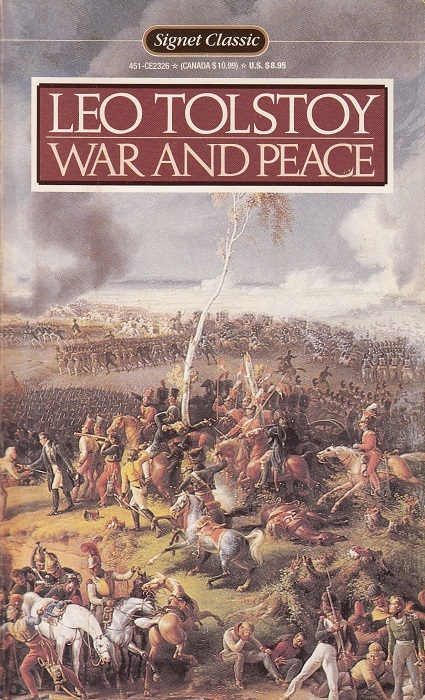

War and Peace by Leo Tolstoy (Translated by Louise and Aylmer Maude)
1869 / 1,394 pgs. (587,000 words) Classic
War and Peace is, to date, the longest novel I have ever read – and it’s a truly epic story. However, describing this book isn’t easy. It avoids simple narration and defies traditional structures. There’s no single central character; instead, the reader follows several individuals, a mix of fictional creations and historical figures. The narrative weaves around significant historical events, such as the Battle of Austerlitz, the lead-up to the French invasion of Russia, and the eventual burning of Moscow.
This novel offers more than just a story; it delves into philosophical questions of right and wrong, personal tragedies, and triumphs. It’s quite common to be following a character’s experiences, only for Tolstoy to digress into a philosophical discussion, such as debating the reasons and responsibility for Moscow’s burning before Napoleon’s arrival.
The narrative structure doesn’t follow a conventional pattern, yet somehow, it works. While reading, I sensed Tolstoy’s desire to innovate beyond the traditional novel format. Deeper into the book, I initially suspected Tolstoy’s main goal was simply to write about the burning of Moscow, using the surrounding story merely as a backdrop to convey the events of the occupation. While I was wrong about his sole focus being the Moscow fire, I was right that he structured the narrative purposefully to tell a larger story.
The story unfolds within the world of Russian aristocracy, an environment Tolstoy, as a Count himself, knew intimately. We follow numerous characters throughout the novel – some you grow to love, others to dislike. Pierre Bezukhov provides a fascinating example. He begins as the illegitimate son of a dying Count, with many hoping to inherit the vast fortune. Believing he’ll receive nothing, Pierre is unexpectedly thrust into the highest echelons of aristocracy when his father leaves him everything. This sudden change confuses Pierre, who feels unprepared for the responsibility and is still searching for his purpose in life. Much of his journey involves this search for meaning, during which others sometimes take advantage of his nature, including his wife, who gains access to much of his fortune.
Another compelling character is Natasha Rostova, a beautiful young countess. She falls in love and becomes engaged to the older Prince Andrei. As part of an agreement with Andrei’s father, they must wait a year before marrying, during which Andrei serves in the military and tours Europe. Natasha waits, though unhappily, feeling her youth slipping away. During this time, she develops strong feelings for Andrei’s friend, Pierre Bezukhov. Tolstoy intriguingly portrays this period from Natasha’s perspective, allowing the reader to feel her painful anticipation for Andrei’s return, mingled with the awareness of passing time.
As mentioned, exploring War and Peace is a vast undertaking. Readers face a few challenges, common for novels of this scale: primarily keeping track of the numerous characters and managing the book’s sheer size. Dedicating enough time is crucial; realistically, plan for at least two to three months to journey through it.
Interestingly, I read the novel on my iPad, despite owning a paper copy. The electronic format offered a significant advantage: easy translation. Tolstoy often incorporates French phrases and sentences into the dialogue – reflecting the fact that much of the Russian aristocracy at the time spoke French. While understanding the French isn’t essential to follow the plot, translating it (which was simple using the tablet’s highlight feature, far easier than juggling a dictionary) definitely enhances the reading experience and provides richer background context.
So, is dedicating the time worth it? Absolutely. I found War and Peace surprisingly readable. It wasn’t the overly complicated text I had feared – perhaps I’ve just become more accustomed to reading such books now. While the first 100 pages or so are quite dense, the narrative smooths out considerably afterwards. The main challenge truly is its length, not its complexity.
Once you reach the final page, there’s an immense sense of gratification that comes with having completed such a masterpiece. For me, it echoed the feeling I had after finishing The Stand – another classic, famously long novel.
Enjoy a good cup of coffee and a delightful book!
Lopaka
Interesting Notes
While reading War and Peace, I initially assumed Tolstoy’s primary goal was to write about the French occupation of Moscow in 1812, creating the surrounding narrative simply to support that event. However, I learned the reality was quite different.
Tolstoy originally intended to write about the Decembrists returning from exile (an event occurring much later than the novel’s timeline). But he realized he couldn’t adequately portray their return without first explaining the Decembrist revolt of 1825. To explain 1825, he felt it necessary to narrate the pivotal events of 1812, including the French invasion. Going back further, he determined he couldn’t properly set the stage for 1812 without exploring the precursor events around 1805, such as the Battle of Austerlitz.
And that is where War and Peace actually begins. By the time Tolstoy finished, he had crafted a 1,300-page epic that covered the years leading up to and including 1812, but he never reached the Decembrist events he had originally set out to chronicle. So, while the novel was conceived to eventually narrate specific historical moments, it grew into a monumental work that laid the groundwork but stopped before reaching that initial destination.
Furthermore, reading about Tolstoy’s own life, I realized how closely the character of Pierre Bezukhov mirrors aspects of Tolstoy’s own experiences and philosophical searching.
 nyghteulen
Many thanks for your interesting post. I’m not a fan of very long texts, and my copy of ‘War and Peace’ sat on the shelves for many years until I had the courage to tackle it. It is a good story in so many ways – but I can’t forgive Tolstoy for taking the wonderful Natasha and making her desperate to fulfil her ‘essential’ womanly role, then turning her into a baby-machine once married. Of his times, I suppose, but I expected more of him. I used to teach ‘Anna Karenina’ many years ago, and felt that he punished Anna for not sticking to the role society demanded of her. He was only human, I guess, and a good writer – just not one of my favourites. Thanks for sharing your thoughts. 😊