
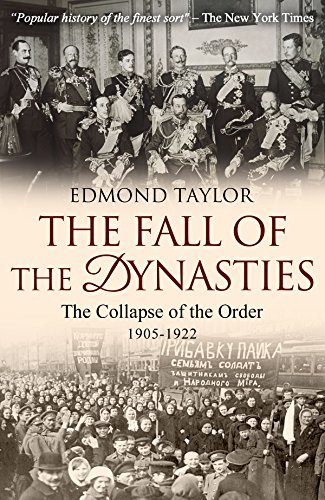

The Fall of the Dynasties: The Collapse of the Old Order: 1905-1922 by Edmond Taylor
1962 / 432 pgs. ( ~ 120,000 words) History
The Fall of the Dynasties chronicles the collapse of four great empires at the end of World War One: the Ottoman, Hohenzollern, Habsburg, and Romanov dynasties. Taylor begins with the assassination of Franz Ferdinand in Sarajevo, then systematically examines each empire’s structure and internal weaknesses. He explores fascinating details like the lack of formal education among Ottoman sultans and the brutal palace competition among women vying for their sons to inherit the throne. For the Austrians, he reveals how Franz Ferdinand was widely disliked within his own empire, and even more striking, how cruelly his wife Sophie was treated by the royal court.
The narrative builds toward the outbreak of World War One, though Taylor notably doesn’t focus on the war itself. Instead, he examines how each empire crumbled under the war’s pressures.
The Romanovs receive the most extensive coverage, from the family’s deteriorating situation through the Russian Revolution to their execution in 1918. The German Empire’s fall follows, with the Kaiser’s abdication coming just one day before the war’s end. By contrast, the Habsburg collapse feels rushed, and the Ottoman Empire section seems hastily tacked on to complete the book’s premise.
While reading, I kept wondering why this book isn’t standard reading for World War One students—until the editorial issues became apparent. Taylor has a frustrating habit of briefly mentioning a historical figure, then reintroducing them chapters later with fuller context, presumably hoping readers will have an “aha” moment. Instead, I constantly flipped back through my notes to confirm whether I’d encountered someone before. This made following each empire’s narrative unnecessarily challenging.
The Kindle edition I read suffered from numerous spelling and punctuation errors, including missing periods that disrupted the flow. Taylor’s vocabulary is undeniably expansive, but the dense prose sometimes obscured rather than clarified his arguments. I lost count of how many paragraphs I reread trying to decipher his meaning—and sometimes I simply gave up. The narrative also contains contradictions that an editor should have caught.
Would I recommend this book? Only if you’re genuinely interested in this period of history. I hope the errors plagued only my digital edition and not the printed version. Despite its significant flaws, I did enjoy the book and found myself fascinated by this pivotal moment when the old world order collapsed forever.
Enjoy a good cup of coffee and a excellent book!
Lopaka
 nyghteulen
Pingback: 2026 Book List | nyghteulen