
• Lopaka’s Favorite Books
  • Lopaka’s Review Guide
  • Reading Lists
  • Stephen King List
  • Who is NyghtEulen?

nyghteulen

nyghteulen

Tag Archives: writing

13 Hours

23 Wednesday Sep 2026

Posted by Lopaka in History, Non-fiction, Reading

≈ 1 Comment

Tags

book-reviews, books, cia, Fiction, writing

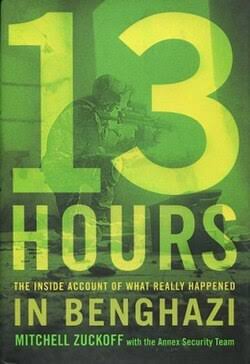
13 Hours: The Inside Accout of what really happened in Benghazi by Michael Zuckoff

2014 / 329 (293 Story) pgs. ( ~ 82,000words) Non-fiction/History

I read with movie soundtracks playing, and every now and then the music lines up perfectly with what’s happening on the page. Partway through 13 Hours, as mortars began falling on the CIA annex in Benghazi, “Forgotten” from the 13 Hours soundtrack started to play. It made an already hard scene hit even harder. It was almost as if I could feel it happening live.

13 Hours by Mitchell Zuckoff, written with members of the Annex Security Team, is the account of the attack on the U.S. diplomatic compound in Benghazi, Libya, on September 11, 2012. Ambassador J. Christopher Stevens had traveled from the embassy in Tripoli to build relations in Benghazi, a city still unsettled a year after Muammar Qaddafi was killed during the Libyan uprising in 2011.

The book centers on the Global Response Staff, CIA security contractors who were former Navy SEALs, Marines, and Army Rangers assigned to protect State Department and CIA personnel. When the compound is attacked and overrun, they gear up to respond but are told to wait. According to their account, that delay may have cost the lives of Ambassador Stevens and information officer Sean Smith. The rest of the night is a desperate fight: searching for the Ambassador, saving everyone they can, and eventually falling back to the annex to hold out until reinforcements arrive from Tripoli.

The hardest part to read comes near the end, when mortars strike the roof of Building C, killing Tyrone “Rone” Woods and Glen Doherty and severely wounding Mark “Oz” Geist. The description of what Oz went through stuck with me more than anything else in the book.

One key note, the book does talk about the investigation and the fallout from this attack. It doesn’t place blame. It allows the dear reader to investigate and draw their own conclusion.

Would I recommend this book? Yes. Overall, 13 Hours is a good, gripping read and worth your time if you’re interested in the event or in military nonfiction. It didn’t quite reach the can’t-put-it-down level for me, but the mortar scene is one I won’t forget anytime soon.

NOTE: One line hit close to home for me. “You can’t shoot back towards it. It’s basically a lottery. If it’s your time, it’s your time, and death can come right out of the sky and kill you in an instant” – 13 Hours This is Jacks thought about Mortars. This was mine…years prior.
The Fall of the Dynasties

08 Sunday Feb 2026

Posted by Lopaka in History, Reading

≈ 1 Comment

Tags

books, Fiction, History, Travel, writing

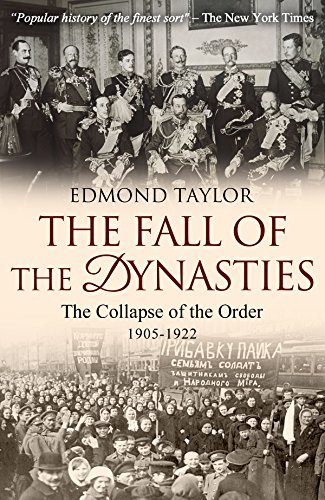
The Fall of the Dynasties: The Collapse of the Old Order: 1905-1922 by Edmond Taylor
1962 / 432 pgs. ( ~ 120,000 words) History

The Fall of the Dynasties chronicles the collapse of four great empires at the end of World War One: the Ottoman, Hohenzollern, Habsburg, and Romanov dynasties. Taylor begins with the assassination of Franz Ferdinand in Sarajevo, then systematically examines each empire’s structure and internal weaknesses. He explores fascinating details like the lack of formal education among Ottoman sultans and the brutal palace competition among women vying for their sons to inherit the throne. For the Austrians, he reveals how Franz Ferdinand was widely disliked within his own empire, and even more striking, how cruelly his wife Sophie was treated by the royal court.

The narrative builds toward the outbreak of World War One, though Taylor notably doesn’t focus on the war itself. Instead, he examines how each empire crumbled under the war’s pressures.

The Romanovs receive the most extensive coverage, from the family’s deteriorating situation through the Russian Revolution to their execution in 1918. The German Empire’s fall follows, with the Kaiser’s abdication coming just one day before the war’s end. By contrast, the Habsburg collapse feels rushed, and the Ottoman Empire section seems hastily tacked on to complete the book’s premise.

While reading, I kept wondering why this book isn’t standard reading for World War One students—until the editorial issues became apparent. Taylor has a frustrating habit of briefly mentioning a historical figure, then reintroducing them chapters later with fuller context, presumably hoping readers will have an “aha” moment. Instead, I constantly flipped back through my notes to confirm whether I’d encountered someone before. This made following each empire’s narrative unnecessarily challenging.

The Kindle edition I read suffered from numerous spelling and punctuation errors, including missing periods that disrupted the flow. Taylor’s vocabulary is undeniably expansive, but the dense prose sometimes obscured rather than clarified his arguments. I lost count of how many paragraphs I reread trying to decipher his meaning—and sometimes I simply gave up. The narrative also contains contradictions that an editor should have caught.

Would I recommend this book? Only if you’re genuinely interested in this period of history. I hope the errors plagued only my digital edition and not the printed version. Despite its significant flaws, I did enjoy the book and found myself fascinated by this pivotal moment when the old world order collapsed forever.

Enjoy a good cup of coffee and a excellent book!

Lopaka

How to read Literature like a Professor

05 Friday Dec 2025

Posted by Lopaka in Reading

≈ 1 Comment

Tags

book-review, books, Fiction, literature, writing

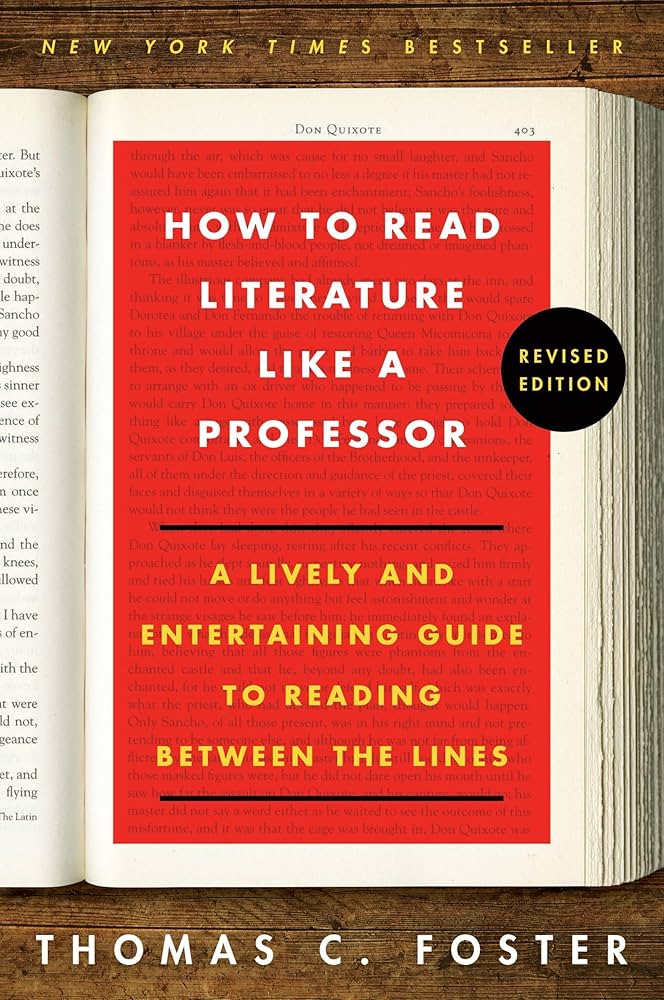
How to read Literature like a Professor by Thomas C. Foster
2003 / 314 pgs. (84,000~ words) Literary Criticism

When I started this book, I expected something entirely different. I honestly thought it would be a guide to reading professional documents effectively or finding key points in technical writing. It wasn’t that at all. However, I was pleasantly surprised by what I found.

The book is a guide to understanding literature on a deeper level by analyzing narrative context. It explains that elements in well-written stories are rarely accidental; they are there to help you visualize scenes or foreshadow events. Even characters are built for specific, structural reasons.

Here are a few highlights I noted:

  • There is no such thing as a new idea. All stories have already been written. When you break down a narrative, you find that authors are inspired by previous authors, who were inspired by those before them.
  • Most plots have ancient roots. Many themes stem from the Bible, Shakespeare, or Greek Mythology. This tradition goes back as far as Virgil writing the Aeneid (19 BC), which mirrors Homer’s Odyssey (8th Century BCE).
  • Weather matters. Rain and snow are rarely just atmospheric. Winter often symbolizes death, while Spring symbolizes rebirth—concepts rooted in the myth of Persephone and Hades.
  • The Hero vs. The Supporting Cast. The hero (almost) never dies, while those around them exist to support the narrative. We often know everything about the hero but very little about the supporting characters because their primary function is to drive the hero’s journey.
  • Violence serves a purpose. In literature, an injury is often a plot device to force one character to interact with another.
  • Symbols are subjective. Symbols mean something different to everyone. If a meaning were completely straightforward, it would be an allegory, not a symbol.

Would I recommend it? Absolutely. I really enjoyed reading it, and I could practically hear my high school teachers saying, “See, I told you this when you were in school!” It genuinely teaches you to read books from a different perspective.

Enjoy a good cup of coffee and a delightful book!

Lopaka

Recent Posts

  • 13 Hours
  • Skeleton Crew
  • If Anyone Builds it, Everyone Dies
  • A Farewell to Arms
  • The Only Woman in the Room

Categories

  • Adventure
  • African American
  • And so it begins…
  • Biography
  • Classic
  • Dark Fantasy
  • Detective
  • Dystopian Future
  • Epic Fantasy
  • Fanasy
  • Fiction
  • Graduate Class Reading
  • History
  • Horror
  • Leadership
  • Military and War
  • Music Reviews
  • Non-fiction
  • Nonfiction
  • Philosophy
  • Political Science
  • Politics
  • Psychological
  • Random Thoughts of a Wandering Mind
  • Reading
  • Realism
  • Running
  • Sci Fi
  • Textbook
  • Thriller
  • Travel
  • Western

Meta

  • Create account
  • Log in
  • Entries feed
  • Comments feed
  • WordPress.com

Blog at WordPress.com.

Privacy & Cookies: This site uses cookies. By continuing to use this website, you agree to their use.
To find out more, including how to control cookies, see here: Cookie Policy
  • Subscribe Subscribed
    nyghteulen
    Join 28 other subscribers

    Have a WordPress.com account? Log in now.

  • nyghteulen
    View site in Reader
    Manage subscriptionsSign upLog in
    Report this content
    Collapse this bar
Loading Comments...