Tags
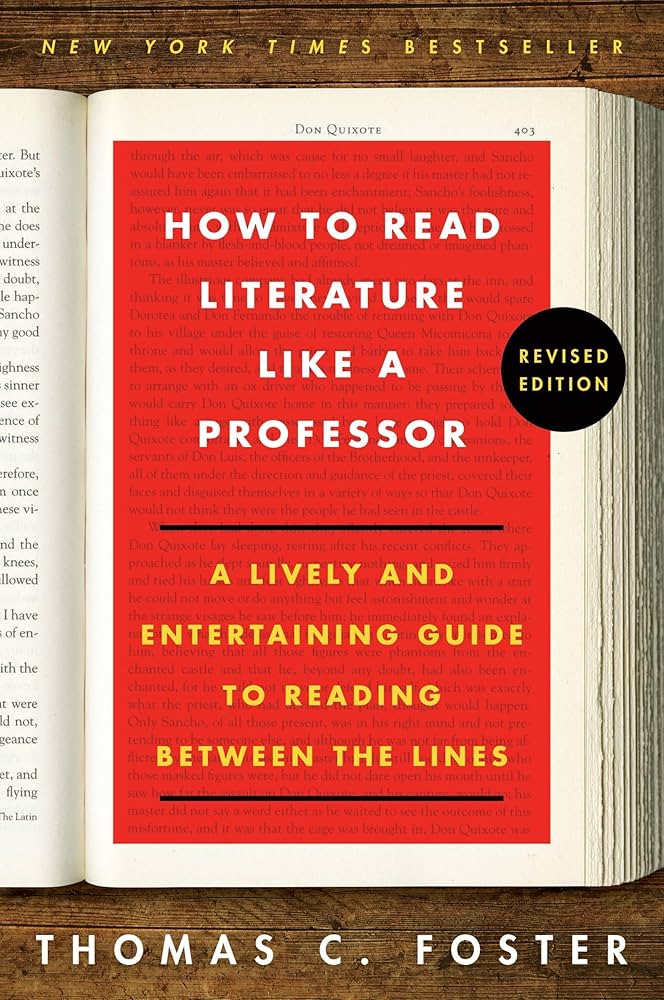

How to read Literature like a Professor by Thomas C. Foster
2003 / 314 pgs. (84,000~ words) Literary Criticism
When I started this book, I expected something entirely different. I honestly thought it would be a guide to reading professional documents effectively or finding key points in technical writing. It wasn’t that at all. However, I was pleasantly surprised by what I found.
The book is a guide to understanding literature on a deeper level by analyzing narrative context. It explains that elements in well-written stories are rarely accidental; they are there to help you visualize scenes or foreshadow events. Even characters are built for specific, structural reasons.
Here are a few highlights I noted:
- There is no such thing as a new idea. All stories have already been written. When you break down a narrative, you find that authors are inspired by previous authors, who were inspired by those before them.
- Most plots have ancient roots. Many themes stem from the Bible, Shakespeare, or Greek Mythology. This tradition goes back as far as Virgil writing the Aeneid (19 BC), which mirrors Homer’s Odyssey (8th Century BCE).
- Weather matters. Rain and snow are rarely just atmospheric. Winter often symbolizes death, while Spring symbolizes rebirth—concepts rooted in the myth of Persephone and Hades.
- The Hero vs. The Supporting Cast. The hero (almost) never dies, while those around them exist to support the narrative. We often know everything about the hero but very little about the supporting characters because their primary function is to drive the hero’s journey.
- Violence serves a purpose. In literature, an injury is often a plot device to force one character to interact with another.
- Symbols are subjective. Symbols mean something different to everyone. If a meaning were completely straightforward, it would be an allegory, not a symbol.
Would I recommend it? Absolutely. I really enjoyed reading it, and I could practically hear my high school teachers saying, “See, I told you this when you were in school!” It genuinely teaches you to read books from a different perspective.
Enjoy a good cup of coffee and a delightful book!
Lopaka
 nyghteulen
Pingback: 2025 Reading list | nyghteulen