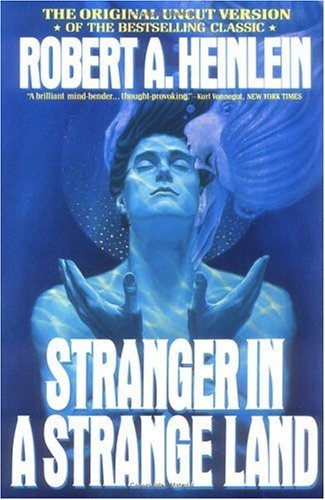
Stranger in a Strangeland by Robert A. Heinlien 1961 / 663 pgs. ( ~ 220,000 words) Sci-Fi Classic
Robert A. Heinlein’s Stranger in a Strange Land is a truly unusual book. The narrative follows Valentine Michael Smith, an orphan born on Mars during the first human expedition. Because the original crew consisted of married couples who engaged in “open relationships” during the journey, Mike’s parentage is unique. He ends up as the sole survivor of the mission, raised entirely by Martians and immersed in their language and culture. Twenty years later, a second mission discovers him and brings him back to Earth. As a man who has never experienced human life, Mike is the ultimate “Stranger in a Strange Land.”
From Narrative to Pontification
Early on, I expected a fascinating exploration of how Mike would perceive and experience our world. Unfortunately, that isn’t quite the book I got. Instead, the narrative often takes a backseat to other characters pontificating about the rights and wrongs of society. While the plot circles around Mike, the pages are dominated by lengthy debates on various social challenges.
A central figure in this is Jubal Harshaw (M.D., LL.B., Sc.D.). After Mike is essentially kidnapped by a nurse named Jill and taken to Jubal’s home, the story shifts. It quickly becomes clear that Jubal is a stand-in for Heinlein himself. Much of the book consists of Jubal engaging in discussions where he clearly holds the “correct” answer and must convince everyone else of his perspective.
The “MacGuffin” Protagonist
One notable example is the debate between Jubal and Duke regarding Mike’s Martian views on cannibalism. While humans find the practice atrocious, Jubal argues that it is an honorable Martian tradition. This pattern repeats throughout the book; Mike often feels more like a MacGuffin—an object used to trigger situations so the author can lecture on religion, money, property, gambling, and sexuality.
Eventually, Mike establishes the Church of All Worlds. Though framed as a mega-church, it functions more like a language school where students learn Martian and embrace its culture, including polygamy. The book feels like a “what if” scenario for someone with unlimited money and a clean slate. Mike begins the story with a child-like innocence, and when he encounters “wrongness,” he simply makes it vanish—much like a child’s fantasy of wishing problems away.
Would I recommend it? It’s an okay book, but I frequently found myself checking the timer to see how much of the story was left. The philosophical debates are incredibly long-winded. I read the uncut version released after Heinlein’s death, and I suspect the shorter, original version might be a tighter, better read. I’m glad I read it for its place in sci-fi history, but it certainly won’t be on my “read again” list.
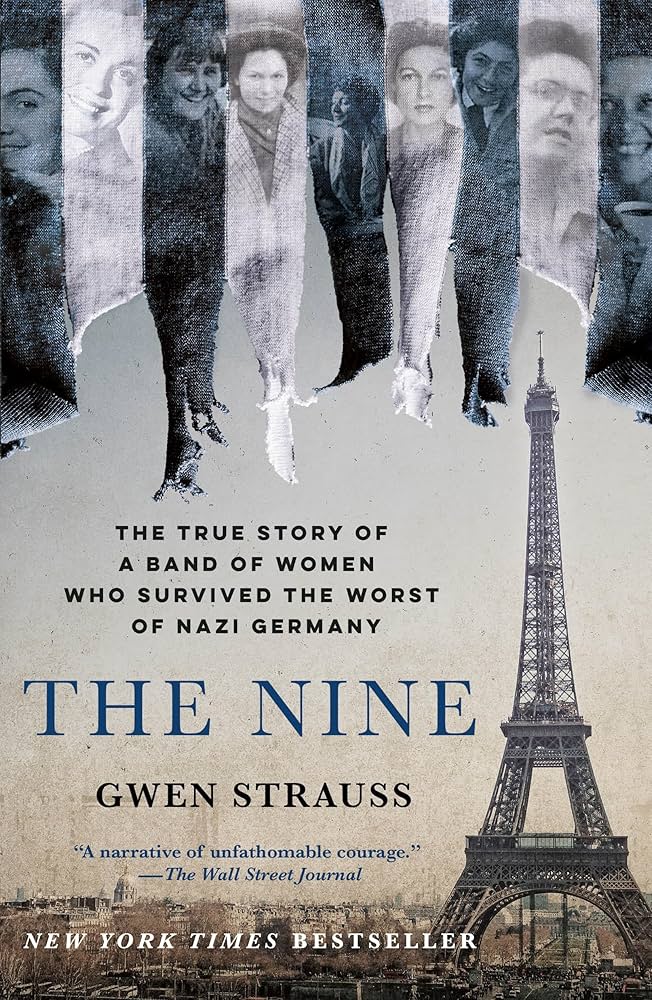
The Nine by Gwen Strauss 2021 / 317 pgs. (84,000~ words) History
This is a deeply emotional narrative. It is a true account of the lives of nine young women, aged 18-26, who served in the French Resistance, were captured, and then sent to the Ravensbrück concentration camp—only to escape during a death march at the end of the war.
The book is not just about their survival; it is a deep dive into who each of these women were. It explores why they joined the Resistance, how they were captured, and the torture they endured at the hands of the SS. It details how they kept their spirits and morale as high as possible in the camps, and how they formed their bond, as they didn’t all meet until they arrived at Ravensbrück.
There is also a wonderful narration of their escape—journeying through village after village, constantly fearing discovery by German soldiers or the SS, which would mean execution. The final section covers their lives after the war and how they were treated—or often forgotten—by the French Government despite their service.
The story is fascinating because, while many have heard of the Holocaust, people often forget the sheer variety of people put into concentration camps. The book mentions several groups often lost to history: the asozial (prostitutes, homosexuals, Sinti and Roma, and common criminals). It describes how this group survived in the same block and how they interacted.
As a person who has visited Dachau, this book really brings into perspective the number of people that Nazi Germany didn’t want in society.
Would I recommend it? Absolutely. It’s a really good book. Just be mentally prepared for what these women went through to survive. It can be heartbreaking.
How to read Literature like a Professor by Thomas C. Foster 2003 / 314 pgs. (84,000~ words) Literary Criticism
When I started this book, I expected something entirely different. I honestly thought it would be a guide to reading professional documents effectively or finding key points in technical writing. It wasn’t that at all. However, I was pleasantly surprised by what I found.
The book is a guide to understanding literature on a deeper level by analyzing narrative context. It explains that elements in well-written stories are rarely accidental; they are there to help you visualize scenes or foreshadow events. Even characters are built for specific, structural reasons.
Here are a few highlights I noted:
There is no such thing as a new idea. All stories have already been written. When you break down a narrative, you find that authors are inspired by previous authors, who were inspired by those before them.
Most plots have ancient roots. Many themes stem from the Bible, Shakespeare, or Greek Mythology. This tradition goes back as far as Virgil writing the Aeneid (19 BC), which mirrors Homer’s Odyssey (8th Century BCE).
Weather matters. Rain and snow are rarely just atmospheric. Winter often symbolizes death, while Spring symbolizes rebirth—concepts rooted in the myth of Persephone and Hades.
The Hero vs. The Supporting Cast. The hero (almost) never dies, while those around them exist to support the narrative. We often know everything about the hero but very little about the supporting characters because their primary function is to drive the hero’s journey.
Violence serves a purpose. In literature, an injury is often a plot device to force one character to interact with another.
Symbols are subjective. Symbols mean something different to everyone. If a meaning were completely straightforward, it would be an allegory, not a symbol.
Would I recommend it? Absolutely. I really enjoyed reading it, and I could practically hear my high school teachers saying, “See, I told you this when you were in school!” It genuinely teaches you to read books from a different perspective.
The Forever War by Joe Haldeman 1977 / 285 pgs. (95,716 words) Si-Fi Classic
In Joe Haldeman’s classic science fiction novel, The Forever War, we meet William Mandella, a physics student whose advanced education gets him conscripted into the United Nations Expeditionary Force (UNEF). After grueling basic training on Earth, he is sent to Charon, a desolate planetoid beyond Pluto, where the training proves lethal for several recruits. From there, Mandella is thrown into a brutal, centuries-long war against a mysterious alien race known as the Taurans.
Mandella and his fellow soldiers travel between star systems using “collapsars,” which allow their ships to cross light-years in an instant. However, this instantaneous travel comes with a staggering cost due to time dilation. While Mandella ages only a few months or years on a mission, centuries fly by on Earth. He becomes a stranger to the very world he’s fighting to protect, which changes beyond recognition with each return.
More Than Just a Sci-Fi Story
At its heart, The Forever War is a profound exploration of the psychological horrors of combat. Haldeman unflinchingly portrays the trauma of losing limbs, the pain of losing loved ones, and the deep alienation of a soldier returning home.
The novel is a powerful allegory for the Vietnam War experience, channeling Haldeman’s own experiences as a veteran into a futuristic setting. The feelings of displacement, the struggle to adapt to a society that has moved on without you, and even the paradoxical desire to return to the simplicity of war will resonate deeply with many readers, especially veterans.
Final Thoughts
Would I recommend it? Absolutely.
The Forever War is a book that deeply impacted me. I was completely engrossed in Mandella’s story, eager to see how his seemingly endless journey would conclude. It’s a masterful commentary on the futility of war and the enduring humanity of those forced to fight it.
Grab a cup of coffee and dive into this unforgettable classic. You won’t be disappointed.
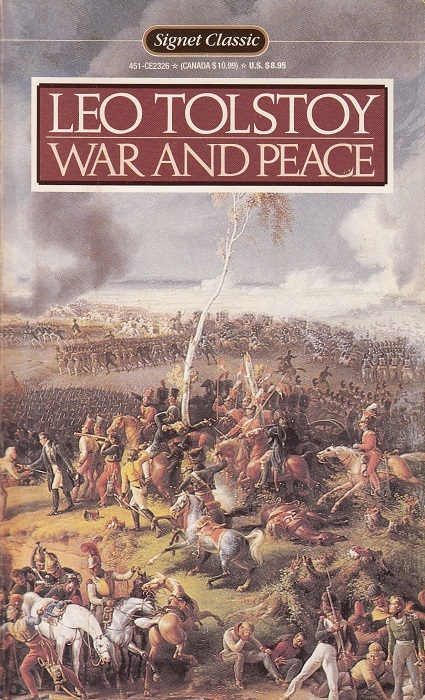
War and Peace by Leo Tolstoy (Translated by Louise and Aylmer Maude) 1869 / 1,394 pgs. (587,000 words) Classic
War and Peace is, to date, the longest novel I have ever read – and it’s a truly epic story. However, describing this book isn’t easy. It avoids simple narration and defies traditional structures. There’s no single central character; instead, the reader follows several individuals, a mix of fictional creations and historical figures. The narrative weaves around significant historical events, such as the Battle of Austerlitz, the lead-up to the French invasion of Russia, and the eventual burning of Moscow.
This novel offers more than just a story; it delves into philosophical questions of right and wrong, personal tragedies, and triumphs. It’s quite common to be following a character’s experiences, only for Tolstoy to digress into a philosophical discussion, such as debating the reasons and responsibility for Moscow’s burning before Napoleon’s arrival.
The narrative structure doesn’t follow a conventional pattern, yet somehow, it works. While reading, I sensed Tolstoy’s desire to innovate beyond the traditional novel format. Deeper into the book, I initially suspected Tolstoy’s main goal was simply to write about the burning of Moscow, using the surrounding story merely as a backdrop to convey the events of the occupation. While I was wrong about his sole focus being the Moscow fire, I was right that he structured the narrative purposefully to tell a larger story.
The story unfolds within the world of Russian aristocracy, an environment Tolstoy, as a Count himself, knew intimately. We follow numerous characters throughout the novel – some you grow to love, others to dislike. Pierre Bezukhov provides a fascinating example. He begins as the illegitimate son of a dying Count, with many hoping to inherit the vast fortune. Believing he’ll receive nothing, Pierre is unexpectedly thrust into the highest echelons of aristocracy when his father leaves him everything. This sudden change confuses Pierre, who feels unprepared for the responsibility and is still searching for his purpose in life. Much of his journey involves this search for meaning, during which others sometimes take advantage of his nature, including his wife, who gains access to much of his fortune.
Another compelling character is Natasha Rostova, a beautiful young countess. She falls in love and becomes engaged to the older Prince Andrei. As part of an agreement with Andrei’s father, they must wait a year before marrying, during which Andrei serves in the military and tours Europe. Natasha waits, though unhappily, feeling her youth slipping away. During this time, she develops strong feelings for Andrei’s friend, Pierre Bezukhov. Tolstoy intriguingly portrays this period from Natasha’s perspective, allowing the reader to feel her painful anticipation for Andrei’s return, mingled with the awareness of passing time.
As mentioned, exploring War and Peace is a vast undertaking. Readers face a few challenges, common for novels of this scale: primarily keeping track of the numerous characters and managing the book’s sheer size. Dedicating enough time is crucial; realistically, plan for at least two to three months to journey through it.
Interestingly, I read the novel on my iPad, despite owning a paper copy. The electronic format offered a significant advantage: easy translation. Tolstoy often incorporates French phrases and sentences into the dialogue – reflecting the fact that much of the Russian aristocracy at the time spoke French. While understanding the French isn’t essential to follow the plot, translating it (which was simple using the tablet’s highlight feature, far easier than juggling a dictionary) definitely enhances the reading experience and provides richer background context.
So, is dedicating the time worth it? Absolutely. I found War and Peace surprisingly readable. It wasn’t the overly complicated text I had feared – perhaps I’ve just become more accustomed to reading such books now. While the first 100 pages or so are quite dense, the narrative smooths out considerably afterwards. The main challenge truly is its length, not its complexity.
Once you reach the final page, there’s an immense sense of gratification that comes with having completed such a masterpiece. For me, it echoed the feeling I had after finishing The Stand – another classic, famously long novel.
Enjoy a good cup of coffee and a delightful book!
Lopaka
Interesting Notes
While reading War and Peace, I initially assumed Tolstoy’s primary goal was to write about the French occupation of Moscow in 1812, creating the surrounding narrative simply to support that event. However, I learned the reality was quite different.
Tolstoy originally intended to write about the Decembrists returning from exile (an event occurring much later than the novel’s timeline). But he realized he couldn’t adequately portray their return without first explaining the Decembrist revolt of 1825. To explain 1825, he felt it necessary to narrate the pivotal events of 1812, including the French invasion. Going back further, he determined he couldn’t properly set the stage for 1812 without exploring the precursor events around 1805, such as the Battle of Austerlitz.
And that is where War and Peace actually begins. By the time Tolstoy finished, he had crafted a 1,300-page epic that covered the years leading up to and including 1812, but he never reached the Decembrist events he had originally set out to chronicle. So, while the novel was conceived to eventually narrate specific historical moments, it grew into a monumental work that laid the groundwork but stopped before reaching that initial destination.
Furthermore, reading about Tolstoy’s own life, I realized how closely the character of Pierre Bezukhov mirrors aspects of Tolstoy’s own experiences and philosophical searching.
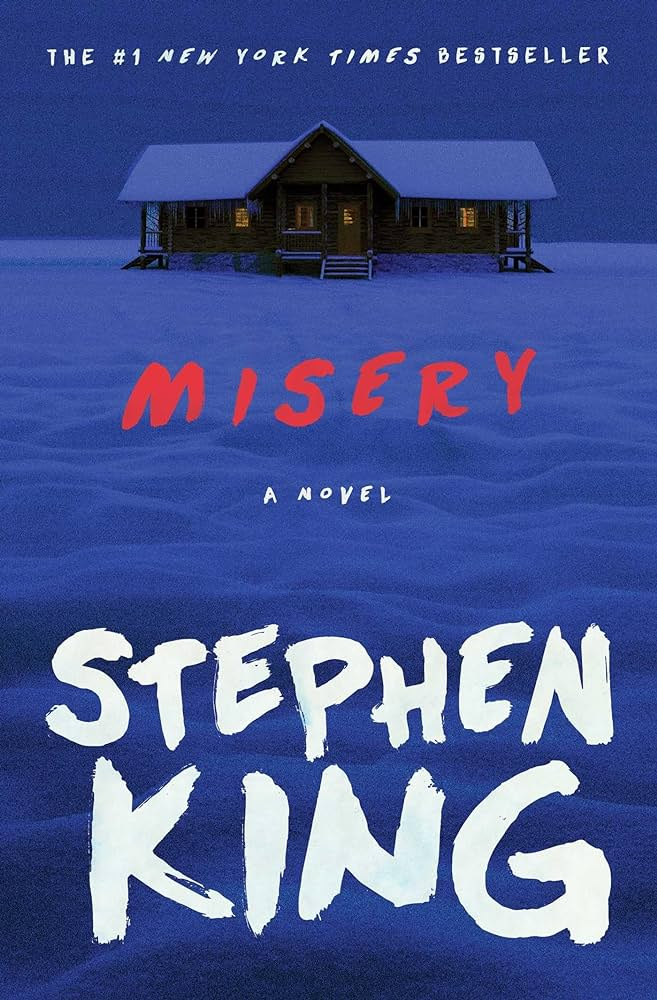
Misery by Stephen King 1987 / 454 pgs. (110,565 words) Psychological-Horror-Thriller
Misery, a classic by Mr. King. It grips you from the start and does not let go. Paul Sheldon, author of the Misery Chastain novels wakes up from a confused and drugged out haze. As he gathers his wits and surroundings, he feels agonizing pain from his hips and below. He meets his savior, Mrs. Annie Wilkes, not only a former nurse, but also his number-one fan. Also, he realizes that he is not in a hospital being cared for by trained professionals but held against his will at Annie’s house. However, with two shattered legs, he is not going to be leaving anytime soon.
Annie loves the Misery books and really does not care for Pauls other works. As he has heard and read from other fans, please, just write those wonderful Misery books –signed, your number-one fan. His latest manuscript was in the car that Annie pulled him from. She reads it and finds it horrible, his worst writing ever. She did mention that she was waiting for the latest Misery book, Misery’s Child, to be released in paperback. What she does not know yet is Paul killed Misery. He despises Misery Chastain, as he feels he can write a lot more than just romance novels that swoon all of his fans. Once Annie has Misery’s Child in hand and devours it, she is terribly upset, and blames Paul for murdering Misery.
With the help of a BBQ pit, Annie demands Paul to burn his latest manuscript, the horrible book called Fast Cars. Once that is complete, she brings him an old Royal typewriter and has him author a book just for her, the greatest novel he has ever written, Misery’s Return! That, dear readers, is the first fifty pages of this masterpiece, for it only gets worse for Paul, much worse as he drafts the only book that will keep him alive.
Annie Wilkes, I believe is one of Mr. Kings greatest antagonist. She is one of the most polarizing characters because you are not sure what she will do at any given moment. This effectively makes the narrative an on-the-edge of your seat experience. The conclusion is incredibly satisfying with frightening consequences.
This novel, I felt, was a narration of frustration from Mr. King as he feels like Paul in various interactions with fans that have played out over the years. Considering, Mr., King received backlash from fans after the release of Eyes of the Dragon. Many fans just demanded him to continue writing horror books. I would imagine it was the same feeling that Tom Clancy received when Red Storm Rising was published, which was not a Jack Ryan novel, and readers demanded another Ryan book. I could imagine many authors reading this novel and stating, “that is how I feel”. Geroge R. R. Martin faces this all the time with his fans demanding for the author to sit a write Winds of Winter and do nothing else until it is complete.
Would I recommend this book, oh yeah! It is a great read and did not disappoint.
Enjoy a good cup of coffee and a delightful book! Lopaka
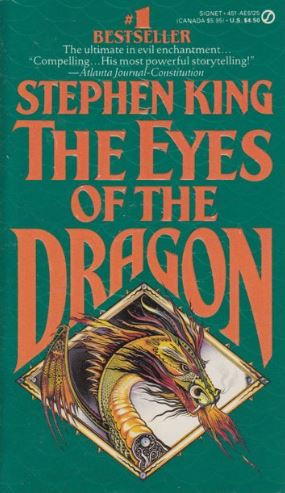
Eyes of the Dragon by Stephen King 1984/ 378 pgs. (90,335 words) Fantasy
Eyes of the Dragon, a different book than what we are used to, from Mr. King. When I read this book over 30 years ago, I was deep into fantasy books like the Dragonlance Saga. This is one the first books that I saw the title, read the short intro on the back cover, took it home from the school library, read it and thought, this book sucks! It was my first foray into the world of Mr. King. Reading this book again with fresher eyes and a different expectation, I was not jaded when I first finished it.
In the book, we get reintroduced to Flagg. He is the Magician that “advises” the King of Delain, Roland. Not the same Roland from the Gunslinger. Flagg thirst for chaos and sets things in motion to see that it happens. He arranges for those that stand to block his pursuit of chaos for the Kingdom with death or imprisonment.
Flagg arranges for the death of the Queen, Sasha, while she gives birth to Thomas, the second in the line to the throne. Flagg felt that Sasha was starting to gain influence of King Roland that would interfere with Flaggs plans. Peter, the first born, was like his mother and Flagg could see that when Peter became King, he would dismiss Flagg as his advisor. Thomas, on the other hand, was like his father, King Roland, and easily swayed by the powerful influence of the Magician.
Flagg arranges for Peter to be charged and found guilty of the vicious murder of his father, King Roland, and imprisoned for life in the great tower called the Needle. His younger brother, Thomas, becomes King at the age of twelve. With King Roland and Queen Sasha dead, Prince Peter locked in the Needle, Flagg has complete control over King Thomas to create the Chaos that he desires for the Kingdom of Delain. This, dear reader, is all I will tell you about the story.
Mr. King wrote this in a narrative form as if he were a bard or great storyteller reciting the plot to you and even includes his own thoughts in the story.
Would I recommend this for reading, not really. Still not one of his great novels and for a Stephen King book, not what you would expect. It is not horrible, just not even in the top tell books that I would recommend from Mr. King.






 nyghteulen